
The Botanical Riches of Namaqualand
A Global Biodiversity Hotspot
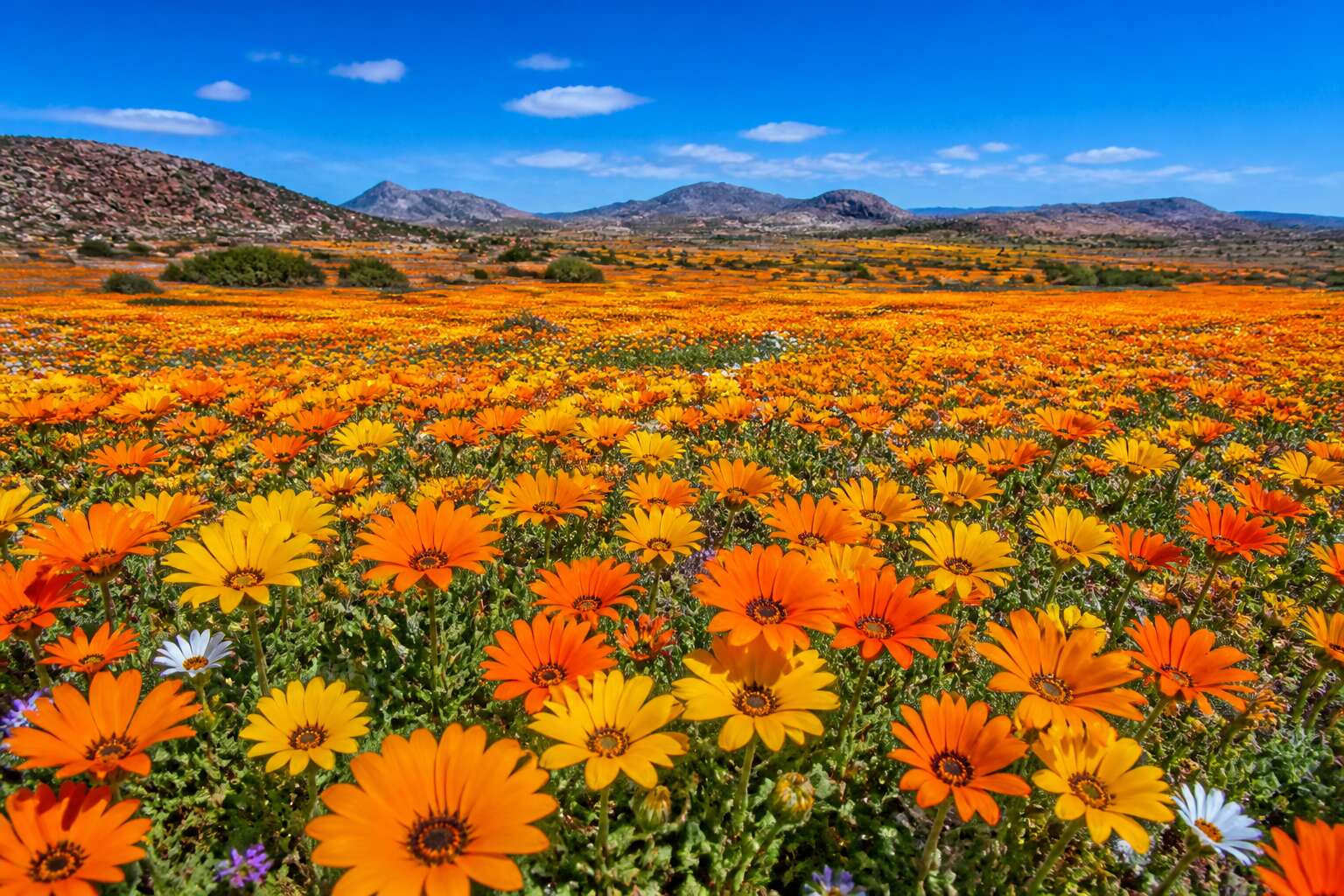
This arid expanse holds a secret that defies its barren reputation. For a few fleeting weeks each year, over 1,000 floral species erupt from the dust in a spectacle of such intensity it renders the landscape almost unrecognizable. This is the Namaqualand flower season, a biological phenomenon where the seemingly lifeless earth transforms into a corridor of colour.
This botanical explosion is not random chaos; it is a masterclass in survival. Each plant has adapted to a punishing climate where rain is a luxury and the sun is relentless. The strategies below are why this region is considered a global hotspot.
– Geophytes, which are underground storage organs, lie dormant for years.
– Annuals complete their entire life cycle in a matter of weeks.
– Succulents, like the iconic halfmens, store water in their swollen tissues.
The sheer concentration of unique flora here is staggering. Of the nearly 6,000 plant species found in this specific area, a significant portion exists nowhere else on Earth. These northern cape flowers are not merely pretty; they are a living library of genetic resilience. Their presence dictates the survival of local pollinators, from solitary bees to sunbirds. The timing of their bloom is a high stakes gamble, a race against the heat to secure the next generation of seed.
Unique Adaptations of Desert Flora
In Namaqualand, the northern cape flowers rely on precise rainfall cues. Seeds may wait years in the soil, germinating only after a downpour that guarantees sufficient moisture for a complete reproductive cycle. This threshold response prevents wasted effort, as a premature sprout would perish under the harsh sun.
Physical adaptations also minimize water loss and heat damage. Common mechanisms include:
- Succulent leaves that store moisture and reflect intense sunlight.
- Underground storage organs that insulate against extreme surface temperatures.
- Dense hairs or waxy coatings that slow transpiration rates.
These traits allow the flora to photosynthesize and set seed within a few weeks. For the northern cape flowers, this brief burst is a survival strategy refined through countless dry seasons. The resulting display is a functional outcome of evolutionary pressure, not a random spectacle.
Endemic Species Found Nowhere Else
Roughly 1,000 plant species in Namaqualand are found nowhere else, a concentration that asks botanists to rethink how aridity shapes diversity. Nearly half of the succulent families present here rely on the winter rainfall zone, and the northern cape flowers represent a distinct evolutionary branch of the Mesembryanthemaceae. Among them are several genera restricted to small quartz fields, including a host of dwarfleaf species.
These include the living stones (Lithops) that mimic individual pebbles,and Conophytum species whose bodies often fit beneath our fingernail. In a single hectare, up to 70 endemic species can coexist,a density that rivals tropical forests. Each occupies a microhabitat:a quartz gravel patch,a shaded crevice,or a shallow depression under algae-coated rocks.
The northern cape flowers are more than a spring bloom. They hold genetic material found nowhere else, shaped by ancient soils and the cold Benguela current.
The Role of Succulents and Geophytes
The winter rains in Namaqualand trigger a transformation so abrupt it feels orchestrated. One week the quartz fields appear barren, the next they are studded with the fleshy, jewel-toned leaves of succulents. Beneath this visible layer, however, lies a hidden engine of survival.
Geophytes are the silent strategists of this region. These bulbous plants retreat entirely underground during the scorching summer months, storing water and energy in their swollen roots. This subterranean dormancy allows them to bypass the brutal drought entirely, exploding into flower only when the soil moisture signals safety. It is a life cycle governed by patience, not speed.
Consider the specific adaptations that make this ecosystem function:
- The “window plant” species, which bury themselves in the soil, leaving only translucent leaf tips exposed to channel light down to their photosynthetic cores below the surface.
- Numerous daisy species that track the sun across the sky, maximizing radiation absorption during the short growing season while simultaneously heating their centers to attract pollinators.
- The compact Conophytum bodies, which reduce surface area to minimize water loss, allowing them to persist on mere millimeters of annual precipitation.
The soil itself dictates the distribution of life. Calcrete flats support one community of succulents, while granite domes host another, entirely distinct set of species. This geological patchwork creates a mosaic of isolation, forcing plants to adapt to extremely localized conditions. The resulting diversity is staggering, yet it rests on a fragile foundation. These specific northern cape flowers are not merely beautiful; they are the product of a precise, unforgiving chemistry between rock, rain, and time, and they exist nowhere else on Earth.
When the Desert Transforms: Blooming Season
Spring Rainfall and Its Trigger Effect
In the arid expanse of the Northern Cape, life operates on a secret timer. It is not the calendar that dictates the season, but the sky. When the first winter rains finally soak the parched earth, they act as a chemical key, unlocking a phenomenon that draws visitors from across the globe. This is the spring bloom, a fleeting spectacle where seemingly barren landscapes erupt into carpets of vibrant color.
For the northern cape flowers, this transformation is a desperate race against the sun. The moisture penetrates the soil, waking dormant seeds that have waited years for the perfect conditions. A mere 50mm of rainfall can trigger the germination of millions of daisies, which rush to complete their life cycle before the heat returns. This delicate balance means the bloom is never guaranteed; it is a reward for patience and a testament to nature’s resilience.
Visitors planning a trip should look for specific signals that the season is unfolding.
– Check local forecasts for consistent rainfall patterns in winter.
– Look for early sprouts on roadside verges, which indicate the process has begun.
– Be prepared to travel further south, as conditions vary dramatically across the region.
The most iconic displays often occur in Namaqualand, where the orange of the Namaqualand daisy dominates the horizon. However, the region offers more than just orange; it presents a palette of whites, yellows, and purples that shift with the topography. Witnessing this event is about understanding the fragility of the ecosystem, where a single dry season can mean the difference between a vibrant meadow and a dusty plain. It is a powerful reminder of how weather patterns directly shape the unique character of this South African landscape.
Peak Bloom Months and What to Expect
Timing is everything when chasing the wildflower phenomenon, and the Northern Cape flowers operate on their own schedule. Generally, the spectacle begins in late July and stretches into September, but the peak varies depending on which region you target. The more arid areas around Springbok and Kamieskroon often burst into colour first, while the coastal plains near Garies lag slightly behind.
The progression follows the rainfall. Early winter showers kick things off in the far north, and as the season matures, the bloom travels southward. A rich display in one valley does not guarantee the same for another, so flexibility is your greatest asset. If you arrive in early August, you may catch the initial wave of daisies, whereas September brings a wider variety of species but with a risk of the heat already shutting things down.
Ultimately, the northern cape flowers reward those who watch the skies more than the calendar. Two weeks of follow-up rain can extend the season, while a hot, dry spell can end it abruptly. For the most reliable experience, aim for mid to late August, when the balance between warmth and moisture is often at its perfect equilibrium.
How Weather Affects Flower Displays
The desert’s silence breaks with a violence that is almost unsettling. A landscape that has slept in dust for months begins to shudder, and the first pale shoots force themselves through the hard, cracked earth. This is not a gentle awakening, but a desperate, beautiful rupture of life against stone.
Cold nights are the enemy of this transformation. A late frost can murder an entire generation of buds before they even open, leaving only crisp, blackened stems in their wake. Conversely, a sudden, blistering heat wave accelerates the entire show, forcing the northern cape flowers to bloom and scatter their seeds in a furious, brief surge.
The weather does not merely influence the flowers, it is the conductor of this macabre orchestra. Consider the primary forces at play:
1. Cold fronts: They bring the rain, but also the risk of frost that can turn petals to mush.
2. A searing wind: It dries out the soil, wilting blooms within a day and shortening the season.
3. Overcast skies: Daisies refuse to open fully when the sun is hidden, leaving the fields dull and subdued.
Moisture lingers in the soil, but its depth and distribution dictate everything. A thunderstorm that drops a deluge on one plot of land will leave the adjacent valley untouched. Wetland areas become saturated, creating pockets of lush green where the flowers seem to glow against the dark, damp sand. The heat of the sun is the only force that can coax the petals to unfurl, making each clear, cloudless morning a singular moment of potential. Many a traveller has witnessed a field of green buds only to be met with disappointment when the afternoon wind turns to a dry, withering blast.
The spectacle is a high-stakes gamble, where the cards are dealt by the sky. A single week of deceptive calm can bring the entire Namaqualand to a crescendo of colour, while another week of capricious, violent weather can end the show without notice. The beauty is not in its permanence, but in its fragile, volatile nature abbreviated by the erratic moods of the hemisphere.
Early Bloomers vs. Late Bloomers
The first winter rains trigger a sudden response. Early bloomers like the dwarf lachenalias push through the soil within weeks. They grow low and fast, using stored moisture before the sun gains intensity. These pioneers often vanish by mid-August.
Late bloomers follow a different schedule. The iconic orange daisies and vygies wait for warmer soil and longer daylight. They carpet the vast plains from late August into September. Their blooms open only in direct sun, creating a changing display. The timing of these northern cape flowers depends entirely on species biology.
- Early risers: Lachenalia and Babiana species.
- Late starters: Dimorphotheca and Mesembryanthemum.
Observing this sequence requires planning. A visitor arriving in August misses the early gems. Waiting until October sees the final blooms, but risks missing the peak. The northern cape flowers reward those who track the daily forecasts and local knowledge.
Prime Wildflower Viewing Destinations
Namaqua National Park Highlights
Each spring, the arid plains of the Northern Cape transform into a living canvas that rivals any gallery. The spectacle is not confined to a single spot, but certain areas offer unparalleled access to the floral display. For many travelers, the coastal plain near Garies presents the most accessible introduction, where vast stretches of orange and white daisies roll towards the horizon. It is a place where the quiet hum of pollinators underscores a profound sense of renewal.
Further inland, the rugged terrain around the Skilpad Wildflower Reserve provides a different perspective. Here, the proteas and vygies cling to rocky slopes, creating pockets of intense color that contrast sharply with the muted earth tones. While the reserve is a highlight, the journey itself is the true reward. The roads between Kamieskroon and Springbok often reveal impromptu carpets of blossoms that are simply breathtaking. The most rewarding experience often comes from exploring the lesser-known gravel paths, where the concentration of Northern Cape flowers feels untouched and wild, offering a solitude that is hard to find elsewhere.
The Skilpad Wildflower Reserve
The gravel track to Skilpad Wildflower Reserve climbs past crumbling stone walls, and the silence deepens with every kilometre. This highland pocket, roughly 4,000 hectares, holds a density of blooms that the coastal plains cannot match. Here, the northern cape flowers emerge from cracks in the granite, each vygie and protea anchoring itself to a life of slow, deliberate colour.
Walk the upper loop in late morning. The petals open fully by ten, and the light falls sharp across the slopes. Watch for the orange lachenalia that appear only after a soaking rain, or the shy pelargoniums hiding beneath the larger shrubs.
- Morning light, before the wind arrives, is the only time the petals fully stretch
- Footpaths here are unmarked in places, so a slow eye matters more than a map
- Rain in the preceding week will push the late geophytes into sudden bloom
By midday, the heat forces the flowers to close, and the reserve settles back into its patient wait for the next visitor.
Goegap Nature Reserve and Its Diversity
Goegap Nature Reserve forces you to walk slowly. The diversity is spatial rather than seasonal; a quartz patch yields different flowers than a rocky rise. I have stood on one ridge, counting a dozen flower types, each claiming a different inch of soil.
- Pale quartz edges sustaining compact vygies
- Deep sandy flats ejecting tall bulbous stems
- Shaded south faces covered in succulent rosettes
That topographic mosaic explains why northern cape flowers endure such sparse rainfall; they do not compete in a single bloom wave. They partition the land into small, separate territories. One morning here requires a slow eye, one that learns to look downward.
The Richtersveld’s Arid Wonders
The Richtersveld does not cater to garden lovers. Northern cape flowers thrive here anyway, wedging themselves into bare rock and surviving on winter moisture that arrives without apology. This is a landscape of stone, heat and stubborn life.
The rewards come to those who look closely at rock faces.
- Conophytums, which hide entirely inside their succulent bodies until rain arrives
- Aloe pearsonii, tall spiky stems rooted into sheer cliffs
- Lithops, whose flowers emerge from stones that seem impossible to crack
These plants offer no carpet of colour. They offer small, stubborn displays. The Richtersveld will test your patience, and the blooms pass that test every season!
Lesser-Known Routes Off the Beaten Path
Most visitors chase the Namaqua coastal blooms after leaving the Richtersveld. I prefer the Hantam Karoo, where northern cape flowers appear in smaller, stranger pockets that reward a slow pace.
The gravel road from Nieuwoudtville to Calvinia cuts through the Bokkeveld Plateau, an escarpment edge that few tour routes touch. Geophytes push through cracked clay pans, and daisies colour the dolerite hillsides. Stop at any bend and you will hear only wind. The silence is absolute. The colour is intense!
- Seasonal wetlands near Oorlogskloof Nature Reserve, dense with bulb species after winter rain
- The old farm tracks southeast of Nieuwoudtville, where orange and purple species intermingle
- The Gannabos reserve outside Calvinia, a reliable stop for spring displays
Timing depends on rainfall patterns, and local farm stalls carry the latest reports. When the conditions align, these routes hold one of the finest concentrations of northern cape flowers in the province.
Photography Tips for Capturing the Blooms
Golden Hour Lighting for Vivid Colors
The fifteen minutes after sunrise and the half hour before sunset transform the arid expanse of the Northern Cape into a painter’s palette. This specific window, the golden hour, is when the low-angled light saturates the landscape, turning the stark earth into a warm canvas. For photographers chasing the elusive Namaqualand daisies, this is the only time the colors truly ignite.
To capture the vividness, you must work with the light rather than against it. The soft rays create long shadows that add depth and texture, while the warmth enhances the orange and yellow pigments of the blooms. Shooting during midday, when the sun is harsh and high, will flatten the scene and wash out the delicate petals.
Here are the core techniques to master for a successful session:
– Use a polarizing filter to reduce glare and boost the natural saturation of the petals.
– Get low to the ground to isolate a single flower against the glowing sky.
– Meter for the highlights to prevent the bright whites and yellows from blowing out.
– Incorporate the surrounding rocks and succulents to provide context and contrast.
When you position yourself with the sun at your back, the colors appear bold and direct. Alternatively, shooting into the light creates a stunning backlit effect, where the petals become translucent and luminous. The key is patience; the wind is your primary adversary, so wait for the calm between gusts to freeze the perfect flower in sharp focus. In this fleeting light, the northern cape flowers offer a spectacle that is both delicate and dramatic, rewarding those who are willing to chase the dawn.
Close-Up Macro Techniques
Some photographers travel thousands of kilometres for the chance to lie flat on their bellies in the dirt. The Northern Cape flowers demand this level of commitment, especially when you want the kind of close-up that makes petals look like stained glass windows. Macro photography here is less about the grand landscape and more about the intimate details that most visitors miss entirely.
The wind is your constant companion, and not always a friendly one. A gentle breeze that feels refreshing on your skin becomes a gale force when you are trying to capture a single daisy in sharp focus. I have learned to time my shots between gusts, waiting for that two second window of stillness.
For those ready to try their hand at this floral portraiture:
1. Use a dedicated macro lens rather than relying on cropping later. The compression and depth of field control are worth every rand.
2. Deploy a diffuser to soften the harsh Karoo sunlight. A simple white business card held at the right angle works in a pinch.
3. Brace yourself against a rock or use a beanbag on the ground. Handheld shots at macro distances magnify every tremor.
4. Focus manually on the stamen, then recompose slightly to let the petals fall into a creamy bokeh.
The northern cape flowers reveal their true character at this scale. Tiny hairs on stems, iridescent patterns in the centres, and the way light refracts through thin petals all become visible. This is where the spectacle of the wildflower season becomes something more intimate.
Composing with the Landscape
The arid expanse of the Northern Cape transforms into a painter’s palette each spring, and capturing that transition requires more than just pointing a lens at the ground. The beauty unfolds in layers, where a single bloom exists in conversation with the stark mountains, the weathered stones, and the endless sky. To photograph northern cape flowers effectively, you must learn to see the entire scene, not just the petals at your feet.
When you step back from the macro world, the landscape offers a powerful framing device. A field of orange gazanias stretching toward a distant koppie tells a story that a close-up simply cannot. Look for natural lines in the earth, like dry riverbeds or animal paths, that draw the eye through the colour. Use the early morning shadows to add depth, or wait for a passing cloud to cast a moving shade that accentuates the vibrant hues against the ochre soil.
To elevate your landscape compositions with these floral subjects, consider these practical approaches:
1. Include a human element, like a hiker on a ridgeline, to provide scale and show the sheer magnitude of the bloom.
2. Shoot from a low angle with a wide-angle lens to make the flowers appear larger and more dominant against the horizon.
3. Use a small aperture, such as f/11 or f/16, to ensure both the foreground blooms and the background mountains remain tack sharp.
4. Isolate a single cluster of flowers and use a rocky outcrop as a natural anchor to balance the composition.
The wind remains your primary adversary in these open spaces, but it can also become an asset. Instead of fighting it, use a slower shutter speed to capture the gentle movement of a grass shrub while the flowers remain static, creating a sense of motion. This technique adds a dynamic energy to the image, contrasting the delicate stillness of the northern cape flowers with the wildness of their environment. The result is a photograph that feels alive, reflecting the true spirit of this resilient and breathtaking region.
Essential Gear for Outdoor Shooting
Over 3,000 species of blooms erupt from this arid soil each spring, and the challenge of documenting them is as much about hardware as it is about patience. When my boots first touched the gravel plains near Kamieskroon, I learned that northern cape flowers exact a toll on careless gear. A weather-sealed camera body and a lens with a broad aperture range give you the flexibility to move from wide landscapes to intimate details within seconds.
The midday glare off light-coloured quartz is brutal, so a polarizing filter is indispensable! Tripod legs need to handle sandy, uneven ground; a spiked tip offers stability. Spare batteries and memory cards are essential because cold mornings and long walks drain both quickly.
Essential gear for field work:
- Macro lens for petal textures and a wide-angle zoom for perspective
- Rocket blower and microfiber cloths for rapid dust removal
- A beanbag stabilizer for low-angle shots without packing a heavy tripod
Avoiding Common Editing Mistakes
The Namaqualand daisies explode across the landscape in a riot of orange, but the real art begins when you review your shots back at camp. Most photographers fall into the same trap with northern cape flowers, and it ruins more images than bad weather ever will.
The first mistake? Cranking the vibrance slider to maximum. The blooms are already intense. Your editing should tame them, not amplify them. Pull back the saturation slightly and let the natural contrast between the purple mesembryanthemum and the sandy earth do the heavy lifting. The harsh desert light creates its own drama, and you simply need to preserve that delicate balance between shadow and petal.
You also need to watch your white balance. The quartzite plains reflect a warm glow that tricks your camera into thinking everything is golden hour. When you edit, check your neutrals carefully. A subtle shift toward a cooler temperature often reveals the true coloration of the northern cape flowers without that artificial sunset look.
Cropping is where most amateurs betray themselves. They try to include the entire scene, but the magic lives in the details. Close in on the daisy head with its layered petals catching the light. Preserve the surrounding context in the frame, but don’t artificially extend it. Cloning tools tempt you to remove that stray twig or footprint, yet over-editing leaves a telltale smear across the flawless sky.
One final misstep involves sharpening. The wind never stops in the desert, and your focus might be slightly soft. Resist the urge to apply heavy structure to every image. A light touch on the midtones keeps the delicate texture of the petals intact while still giving the image that crisp edge. The northern cape flowers reward patience in the field and restraint behind the screen. Trust what you captured and nudge it gently toward perfection.
Planning Your Flower Viewing Road Trip
Self-Drive Itineraries from Cape Town
Planning a self-drive to see the northern cape flowers requires logistics, not just enthusiasm. The allure of a million daisies is strong, but the distances here are genuinely immense. From Cape Town, you face a solid 540 kilometers to the first reliable sighting. This is not a casual Sunday drive. You need a plan that respects the fuel gauge and your own stamina.
The journey itself is part of the spectacle. As you cross the Cederberg and enter the Hantam region, the landscape transforms. For a smooth trip, consider these pre-departure checks:
- Confirm your vehicle has a full-size spare tire, as cell reception is patchy.
- Book accommodation in Springbok or Kamieskroon well in advance. Flower season sells out.
- Download offline maps for the gravel detours near Garies.
- Pack layers, because the desert mornings are cold enough to bite.
The N7 is your main artery, but the real treasures hide on the secondary roads. A two-day itinerary is workable if you are disciplined. Day one might take you as far as Clanwilliam, allowing you to stretch your legs at the Ramskop Wildflower Garden. Day two pushes you toward the Kamiesberg mountains, where the granite outcrops frame the northern cape flowers beautifully. Break the drive with short stops.
The return trip warrants a different route. Take the R355 via Calvinia and the Tankwa Karoo back to the Cape. This alternative path offers a distinct floral palette and avoids retracing your own tyre tracks. The gravel is manageable for a sedan in dry weather, but a high-clearance vehicle offers peace of mind. Ultimately, the journey hinges on patience. Rushing between viewing spots creates a blur of colour. Pick two or three locations. Sit down. Let the silence of the veld settle in.
Accommodation Options and Booking Tips
Finding a place to rest your head during wildflower season requires as much planning as the route itself. The remote towns of this region have limited lodging, and the demand surges for a brief window each year. You are not booking a simple overnight stay; you are securing a strategic base camp for your daily explorations.
Springbok and Kamieskroon act as the primary hubs for the Namaqua region. They offer a mix of guesthouses, hotels, and farm stays. For those who prefer a deeper immersion, the surrounding farms often provide self-catering cottages that place you right at the edge of the blooming fields. These options allow you to wake up to the sight of the northern cape flowers without a long drive to reach them.
Accommodation sells out months in advance, so early reservations are essential. This is a practical necessity, not a suggestion. Many travelers make the mistake of planning their route first and searching for beds second. The smarter approach is to reverse that order entirely.
– Confirm your nightly stays before you finalize any daily driving distances.
– Look for lodgings with kitchen facilities to save time during busy mornings.
– Ask about the condition of access roads when booking a farm stay.
– Consider staying in one central location rather than moving every night.
The recent trend toward self-catering options has grown, giving visitors more flexibility. Still, the classic guesthouses offer the advantage of local knowledge. Your host can often tell you which specific sections of the park are showing the strongest blooms on any given day. That insight is invaluable when you are working with limited time.
A final consideration involves your booking strategy for the shoulder season. Early September tends to be the peak, but late August can be equally spectacular with fewer crowds. If your dates are flexible, you will find more accommodation options and a quieter experience. The wild display will still be waiting for you, even if you arrive slightly before the masses do. Just make sure you have a confirmed place to rest, because the days are long and the landscape demands your full attention.
Road Conditions and Safety Measures
The drive to see the northern cape flowers is an adventure in itself, but it demands respect for the vast, semi-arid landscape. Distances between towns are long, and cellphone reception can vanish the moment you leave the main routes. Before you set off, check the latest weather forecasts, but know that conditions can change quickly.
The roads themselves are a mixed bag. While the N7 is tarred and reliable, the real magic often lies on the gravel byways that branch off towards the wildflower reserves. A good rule of thumb is to slow down on these paths; corrugation can rattle your vehicle and loose stones are a hazard. A standard sedan can handle most of them if driven with care, but a high-clearance vehicle gives you more confidence.
Here is a quick checklist to run through before you leave your guesthouse each morning:
– Fill up your fuel tank whenever you drop below half. Petrol stations are scarce in the remote areas.
– Carry at least 5 litres of drinking water per person, plus extra for the radiator.
– Download offline maps for your phone, as GPS signals can be unreliable.
– Pack a basic first-aid kit and a physical map as a backup.
– Tell someone at your accommodation which route you plan to take for the day.
When you do stop to photograph the flowers, be mindful of the weather. The sun here is intense, and a sun hat and high-SPF sunscreen are non-negotiable. Also, keep an eye out for sudden dust storms, which can reduce visibility to almost zero within minutes. If one approaches, pull over and switch on your hazard lights until it passes.
One final note on timing: the best light for photography is in the early morning or late afternoon, but these are also the times when wildlife is most active. Drive defensively, especially at dawn and dusk, to avoid collisions with baboons or livestock that wander onto the roads. And remember, the flowers are fragile. Stick to designated paths and viewpoints to help preserve the display for the next visitor. The northern cape flowers reward the careful traveller, so plan your days with buffer time to simply enjoy the scenery without rushing.
Packable Essentials for a Day Trip
Planning a day trip to see northern cape flowers demands careful thought about what you carry. The vastness means hours on the road, so preparedness is key.
Pack multipurpose items. A wide-brimmed hat and light long sleeves shield against sun, while a windbreaker handles sudden gusts. Bring a reusable bottle and high-energy snacks, as facilities are sparse.
- A power bank for your phone.
- Binoculars to spot blooms from a distance.
- A small bag for your litter.
Balance weight with necessity. Never skip hydration or sun protection. When you finally stand among the fields of colour, you will appreciate having planned ahead, allowing you to simply enjoy the moment without worry.
Preserving Floral Diversity for Future Generations
Threats from Climate Change and Mining
The same landscapes that draw thousands of spring visitors face pressures that could reshape their botanical character. As seasonal rainfall patterns become less predictable, the delicate germination windows for many northern cape flowers are narrowing. Warmer temperatures push some species to seek cooler refuges, yet the fragmented nature of their habitats limits how far they can migrate naturally.
Mining operations present an immediate and tangible challenge. The very geology that makes this region so mineral-rich also makes it vulnerable to extensive surface disturbance. These excavations can remove entire populations of endemic bulbs and succulents in a single operation. The cumulative impact of habitat loss, altered drainage patterns, and dust deposition creates a complex web of threats that requires vigilant management.
– Groundwater extraction for mining can lower the water table, affecting sensitive root systems.
– Rehabilitation efforts often struggle to recreate the precise soil chemistry and microclimates that these specialised plants require.
– Pollution from processing activities can contaminate the thin, nutrient-poor soils.
Preserving this floral diversity is fundamentally about protecting a process of evolution that has unfolded over millennia. This is not a passive exercise, but an ongoing effort to secure the ecological functions that allow these wild blooms to persist. The future of the northern cape flowers depends on conservation strategies that balance economic interests with the irreplaceable value of botanical heritage.
Community-Driven Conservation Projects
Every year, more than 100 000 visitors flock to see the northern cape flowers, but locals are the ones securing their future. Community driven conservation projects are essential. They manage seed banks, monitor rainfall patterns, and clear invasive species that compete with endemic bulbs.
Some initiatives go further. Local farmers lease portions of their land for conservation easements, while women’s cooperatives cultivate rare succulents for sustainable trade. The result is a patchwork of protection that spans private and communal land.
The work takes many forms:
- Removing livestock from sensitive wetlands during germination
- Recording flowering times to track climate shifts
- Training young guides who share knowledge with visitors
I have seen how these efforts keep the northern cape flowers blooming beyond the tourist season. They directly counter mining and climate change. The flowers persist because locals refuse to let them vanish.
The Importance of Responsible Eco-Tourism
Every spring, the dusty plains of Namaqualand erupt in a spectacle that draws tens of thousands of visitors. But the real work happens long after the crowds leave. Preserving floral diversity isn’t just about admiring the view; it’s about ensuring the next generation of blooms has a foundation to grow from.
Community seed banks are the quiet engine of this conservation effort. Here, local hands collect and catalogue seeds from the previous season, creating a living library that safeguards the genetic future of these species. This work is critical, especially when you consider that a single bad season can wipe out an entire population.
For most species, the economic motive is the strongest argument for protection. When the northern cape flowers are thriving, they attract tourists who pay for accommodation, meals, and guided tours. That revenue provides a direct financial incentive for locals to keep the land intact and healthy.
The Value of a Living Landscape
It’s a straightforward economic equation. A field of blooming Namaqua daisies is worth more standing than it is ploughed under for development or stripped for mining.
– A thriving ecosystem supports pollinators and wildlife.
– Healthy soils retain water and prevent erosion.
– Intact landscapes buffer against climate change impacts.
This is why eco-tourism matters. It isn’t just a hobby; it’s a tool for survival. When you pay for a local guide, you are literally paying for the flowers to exist next year. The community sees the direct link between a living flower and a living wage.
The mining industry presents a constant pressure, offering short-term wealth at the cost of permanent loss. Conservation groups and local farmers are locked in a quiet battle against this, using easements and sustainable land management to protect critical habitats. It is a slow, deliberate fight, but one that carries the weight of future springs. The responsibility falls on every visitor to tread carefully and support businesses that contribute to this cycle of preservation. Your footprint should be limited to photographs and memories, leaving nothing but footprints on the sandy paths. It is a delicate balance, but one that is absolutely essential for the region’s survival.
How Visitors Can Contribute to Protection
The spectacle of northern cape flowers is brief. The preservation of their legacy is not. For every visitor who photographs a field of blooms, there is a quiet responsibility to ensure those same bulbs and seeds remain for another season. The land is fragile. Its treasures are easily lost underfoot.
Beyond the obvious rules of staying on paths, true protection requires participation. Travellers can make a tangible difference by making deliberate choices.
– Book with operators who employ local guides and contribute to community funds.
– Purchase seeds or crafts from accredited conservancy projects, not wild harvested goods.
– Report any signs of illegal mining activity or land degradation to park authorities.
These actions carry weight. They shift the balance from passive observation to active guardianship. When your travel money supports a community that values the living landscape, you create an economic argument for preservation that rivals any other industry.
The future of the northern cape flowers depends on this cycle of respect and reinvestment. Your visit is not an ending point. It is a contribution to a continuum that began long before you arrived and will continue long after you leave. Choose to be a part of its survival.


0 Comments