
Understanding Nursing Programmes in the Northern Cape
Types of Nursing Qualifications Offered
Rural clinics in the Northern Cape often run with a single nurse on duty, and the northern cape nursing college exists to change that reality. Programmes are shaped to fit local conditions, where patient loads are heavy and staff work without backup.
The northern cape nursing college provides several entry points depending on your goals:
- Higher Certificate in Auxiliary Nursing, a one year course leading to enrolment as an auxiliary nurse.
- Diploma in Nursing, a three year programme that produces registered staff nurses.
- Bachelor of Nursing, a four year degree for those aiming at professional nurse leadership.
Each qualification builds clinical competence step by step. I have watched graduates from this college move directly into busy clinic rotations with confidence. The curriculum follows South African Nursing Council standards, so graduates are ready for the realities of community health work.
Accreditation and Curriculum Standards
Accreditation determines whether a nursing qualification holds any weight in South African hospitals. The northern cape nursing college operates under the South African Nursing Council’s oversight, which means every module, clinical rotation, and assessment protocol must meet national standards. Without that accreditation, graduates would struggle to register with the SANC, and registration is the key to lawful practice.
Curriculum design at the northern cape nursing college follows a deliberate sequence. Foundational sciences come first, then clinical skills, then community-based training. Each phase builds on the previous one, with competency checkpoints along the way. The college also aligns its teaching with the National Health Insurance framework, preparing students for shifts in primary healthcare delivery.
Clinical placements are arranged with nearby district hospitals and clinics, so students see firsthand the conditions they will face after graduation. In my experience, practitioners who train this way adapt faster when they enter the system.
Clinical Training Opportunities
Walk into any district hospital in the Northern Cape and you will see why practical training defines a nurse’s readiness. Students at the northern cape nursing college rotate through multiple wards:
- Medical and surgical units for acute care
- Paediatric and maternity wards for family-centred nursing
- Primary healthcare clinics for community disease management
Each placement puts students directly in patient care, handling assessments, medication, and emergency response. Rural postings test adaptability. I have seen students thrive in those conditions! That exposure builds clinical acumen, and the demanding hours produce graduates ready for real wards.
Distance Learning vs Full-Time Study
The choice between distance learning and full-time study at the northern cape nursing college is fundamentally a question of temperament. Distance learners occupy a peculiar solitude, negotiating clinical hours at local facilities while mastering theory in isolation. Full-time students experience the opposite, a compressed immersion where ward gossip becomes peer mentorship and lecture halls pulse with collective anxiety.
Consider what each path demands:
- Distance learning requires exceptional self-regulation and the patience to learn anatomy from a textbook at midnight
- Full-time study provides structured supervision but leaves little room for external employment
Neither path produces a superior nurse. They cultivate different capacities. I have watched distance graduates develop fierce independence, while full-time cohorts forge tighter collaborative instincts. The programme structure merely frames the deeper labour of becoming clinically competent.
Admission Requirements and Application Process
Minimum Academic Requirements
Every year, hundreds of applicants compete for limited seats at the northern cape nursing college, yet only a fraction meet the baseline requirements. The gatekeeping starts with your National Senior Certificate or equivalent qualification. You need a minimum of 40% in your home language, 40% in English, and 40% in Mathematics or Mathematical Literacy. Biology or Life Sciences at 50% gives you a distinct advantage.
Your application package must include certified copies of your ID, academic records, and a completed application form. The northern cape nursing college processes applications on a rolling basis, meaning early submission improves your odds.
– Proof of South African citizenship or permanent residency
– A valid email address for correspondence
– Six months of bank statements or proof of financial standing
Once your documents pass the initial screening, the college invites shortlisted candidates for a selection interview. That interview carries as much weight as your marks, and it often becomes the decisive factor.
Required Documents and Certifications
The application process at the northern cape nursing college demands precision. Every certified copy must carry a commissioner of oaths stamp, and incomplete submissions are returned without review. Organise your documents before you begin: identity documents, academic transcripts, and proof of residence.
Once accepted, your certification journey continues. The college manages your student registration with the South African Nursing Council, and this step requires additional items that often catch applicants off guard.
- Certified copy of your ID or passport
- Police clearance certificate issued within the last six months
- Two ID photographs for SANC registration
Applicants who submit complete files typically receive confirmation within ten working days. The northern cape nursing college then issues a provisional acceptance letter, which you will need for your first registration payment.
Application Deadlines and Procedures
Each year, the northern cape nursing college receives far more applications than seats. The decisive factor is rarely academic merit. It is timing. Applications open on the first Monday of August and close at 16:00 on the final Friday of October. Late submissions are rejected.
Apply early! The college reviews files in three batches. The first batch gets first preference. By the third batch, most places are filled. A complete August submission beats a stronger October one.
Once you submit, check the online portal weekly. The northern cape nursing college sends updates through the portal only, not by email or phone. Provisional acceptance appears within ten working days. You have five days to accept and pay the registration fee. Miss that window, and your name drops to the bottom of the waiting list.
The waiting list is active. Dozens of accepted applicants withdraw each year, and the college fills spots in order of application date. Your position depends on when you applied, not your grades.
Selection Criteria and Interviews
Every applicant believes their marks speak volumes. The selection committee at northern cape nursing college hears a different dialect. Interviews are reserved for a small fraction, usually those hovering near the cut-off line. The rest are judged on paper, which makes the written application your single performance.
The criteria extend beyond academic transcripts. Personal resilience, empathy, and a certain composure under pressure are more important than people assume. The interview follows a structured script, not a casual chat. You might face a scenario about a distressed patient.
- Clarity of speech
- Evidence of community involvement
- Ability to stay calm in hypothetical crises
That list counts more than your report card.
International Students and Equivalency
Every year, a small group of international applicants asks whether their hard-earned credentials will travel well. At northern cape nursing college, the answer begins with a South African Qualifications Authority (SAQA) equivalency certificate. Without it, even a brilliant transcript from abroad remains paper. The advisory team evaluates secondary schooling and any prior nursing study against the National Qualifications Framework.
Foreign applicants must prove English proficiency through IELTS or TOEFL. A valid study visa is required at registration. Medical and police clearance from the home country completes the file.
- Submit a SAQA evaluation for every foreign qualification.
- Provide certified translations for documents not issued in English.
- Present your visa and medical records to the admissions office.
This pathway runs parallel to the domestic route. Each international file gets individual attention at northern cape nursing college.
Financial Aid and Bursaries for Aspiring Nurses
Government Bursary Options
Financing your studies at northern cape nursing college can feel overwhelming. The government bursary system exists precisely to remove that burden! These funds cover tuition, accommodation, and sometimes even a monthly stipend, allowing you to focus on clinical skills instead of bank balances.
Provincial health departments allocate a portion of their budgets to nursing students each year. Applicants who commit to working in public facilities after graduation typically receive priority. The arrangement directly supports the public healthcare sector’s staffing needs.
- The provincial Department of Health handles the main bursary applications.
- An acceptance letter from northern cape nursing college is the primary document in any funding file.
- Bursary cycles close earlier than admission windows, so timing matters.
Funding decisions arrive after long waiting periods. Successful applicants receive confirmation before the academic year begins, allowing time to arrange accommodation and books.
Provincial Health Department Funding
In a province larger than Germany yet home to barely a million souls, the distance between a qualified nurse and a vacant clinic post can stretch across empty horizons. Provincial health department funding exists to close that gap.
From my experience, a missing signature has cost capable students a full year. Applicants to northern cape nursing college should scrutinise the service obligation before signing. The bursary covers full tuition, a book allowance, and a monthly stipend, but failure to complete the service period triggers repayment with interest.
Consider the practicalities when applying:
- A certified copy of your South African ID sits at the top of the checklist.
- Proof of household income determines whether you qualify for the full subsidy.
- Placement preferences for rural postings weigh heavily in the selection matrix.
The application window at northern cape nursing college aligns with the provincial cycle, so monitor both calendars. Miss one date and the entire year slips away!
Private Scholarships and Grants
Few private funders look beyond the big-city universities. Yet a quiet network of family trusts and mine-linked bursaries exists for students at northern cape nursing college. These funds rarely advertise, which is why most applicants miss them.
Some require a two year workback at a specific clinic. Others demand only academic progress reports each semester. The application paperwork differs from provincial forms, so treat each fund as its own puzzle.
- Anglo American Chairman’s Fund supports rural health training
- The Transnet Foundation offers nursing bursaries with no bond
- Local church and community trusts sometimes fund textbooks
Private money changes the calculus. A grant from a mining house can cover the monthly stipend gap that provincial bursaries leave open. For students at northern cape nursing college, these grants mean the difference between studying full-time and dropping out to work. The college’s financial aid office holds a private fund list that rarely reaches the internet.
Student Loans and Repayment Plans
A quiet reality emerges when bursaries fall short: student loans must cover the rest. At northern cape nursing college, aspiring nurses often combine a study loan with part time work for living costs. Some loans convert to bursaries after you complete your qualification, which changes how you plan repayment.
Repayment plans depend on your future earnings. You start paying only once your annual income crosses the threshold, and the amount scales with your salary. Private banks offer nursing specific loans with grace periods until you register as a nurse.
Repayment structures include:
- Income contingent plans, where monthly payments match a fixed percentage of your salary.
- Fixed term loans with reduced interest for health workers.
- Employer sponsored repayment, where a rural hospital settles your debt after a service period.
Each option requires paperwork, and the financial aid office at northern cape nursing college can explain the fine print before you sign.
Application Tips for Funding
Every year, hopeful nurses lose funding because their application files miss one detail. The financial aid desk at northern cape nursing college sees the same omissions. To avoid that, treat every form with careful attention. Review every line before you submit.
Funding applications are easier with a checklist. The staff at northern cape nursing college can review your draft. Bring documents to the student support centre. They flag missing signatures or proof of address. That review takes thirty minutes and saves months of waiting.
A strong application includes:
- Certified copies of your ID and parents’ income statements.
- A motivation letter that names your chosen nursing speciality.
- Verified proof of residence for your home province.
Check the closing date for each bursary, not just the college’s deadline. A late application fails even with perfect documents.
Budgeting for Nursing School
Budgeting for nursing school means accounting for items that never appear on the fee schedule. Textbooks, clinical uniforms, and transport to hospital rotations consume cash faster than students expect. At northern cape nursing college, the financial aid office encourages a spending plan. Take that advice seriously!
A budget separates fixed costs from variable ones. Accommodation and fees are fixed. Food, data, and toiletries shift monthly. Tracking these amounts from the first term avoids the scramble. The student support centre at northern cape nursing college offers a budgeting template.
- Set aside an emergency fund for unexpected clinical travel.
- Buy second-hand textbooks from senior students.
- Cook in shared accommodation instead of eating on campus.
Small habits compound. Saving ten rand a day yields over three thousand rand by year end. That money covers registration fees or a stethoscope. Wise planning turns a bursary into a buffer, not a burden.
Career Paths and Job Prospects After Graduation
Public vs Private Healthcare Employment
Nearly 30% of professional nursing posts in South Africa’s public sector remain unfilled, a figure that shapes every graduate’s first job search. For those finishing at northern cape nursing college, the choice between public and private healthcare employment hinges on more than salary.
Public service offers stability, structured community health work, and access to rural postings where clinical exposure is broad. Private facilities, by contrast, tend to provide faster promotion tracks and higher starting packages, though often with greater patient loads.
- Public hospitals: 12 month community service rotations, then permanent posts.
- Private groups: Such as Life Healthcare or Mediclinic, with shift work and specialisation options.
- Agency nursing: Flexible contracts across both sectors.
Either route builds a portfolio, but clinical training at northern cape nursing college gives an edge in underserved areas. That versatility matters!
Specialisation Opportunities
Graduates of northern cape nursing college rarely follow a straight line. The profession rewards those who pivot. Specialisation reshapes a nursing career into something with a signature, a field of mastery that commands respect and higher remuneration.
Consider the options:
– Advanced midwifery, for work in rural clinics where maternal care is scarce.
– Operating theatre nursing, a high-pressure theatre of precision.
– Psychiatry, where emotional intelligence becomes clinical skill.
Each path requires postgraduate study, usually a diploma or degree, and each opens distinct doors. Community service comes first, then the choice: remain generalist or specialise. Those who do specialise often move into management, education, or independent practice within a decade, their northern cape nursing college foundation carrying them further than expected.
Rural and Community Nursing Roles
In the Northern Cape, a nurse with a community health focus often becomes the only medical presence within a hundred kilometres. The province’s sparse population means rural clinics rely on northern cape nursing college graduates who understand mobile health outreach and chronic disease management.
Graduates typically start in primary healthcare facilities, handling immunisations, TB screenings, and maternal checkups. Some move into school health programmes or home-based care coordination. Others join district health teams, where they supervise community health workers and manage outbreak responses.
- Rural clinic nursing
- Mobile health unit rotations
- Community health worker supervision
These roles demand adaptability, but they also offer job security and direct community trust. A northern cape nursing college qualification prepares graduates through practical exposure and applied knowledge. The career path is immediate, and the impact is measurable.
Further Study and Advanced Practice
After completing the programme at northern cape nursing college, graduates enter a job market that values practical experience. Public hospitals in Kimberley and Upington offer immediate posts. Private facilities recruit aggressively for skilled nurses! Some alumni move into workplace health or medical insurance assessment.
Further study changes the trajectory. A post graduate diploma in trauma nursing or paediatrics leads to advanced roles. Master’s study opens research and teaching positions. From what I have seen, the college’s articulation agreements with several universities make this transition smoother.
Career prospects improve with each qualification. Most students secure contracts within months. Additional certifications raise earning potential. The alumni network provides mentorship and supervisory openings.
Salary Expectations and Benefits
Graduates from northern cape nursing college enter a job market with genuine demand. Public hospitals in the province offer immediate contracts, and private facilities recruit aggressively for trained staff. Entry level registered nurse salaries start near R260,000 per year, with night shift allowances and overtime pushing that figure higher.
Employment packages typically include medical aid, pension contributions, and study leave. Rural postings often carry housing allowances because of staff scarcity.
- Public sector: predictable annual salary increments
- Private sector: performance linked bonuses
- Agency nursing: flexible hours and higher hourly rates
Your earning power grows with specialisation. Completing additional certifications through northern cape nursing college pathways raises your market value noticeably.
Life at Nursing School and Student Support
Campus Facilities and Accommodation
The isolation of your first clinical placement is real. But life at Northern Cape Nursing College is built around connection. Student support systems respond early. Counsellors, academic advisors, and senior students are available when pressure builds. That matters during exam season or after a difficult shift.
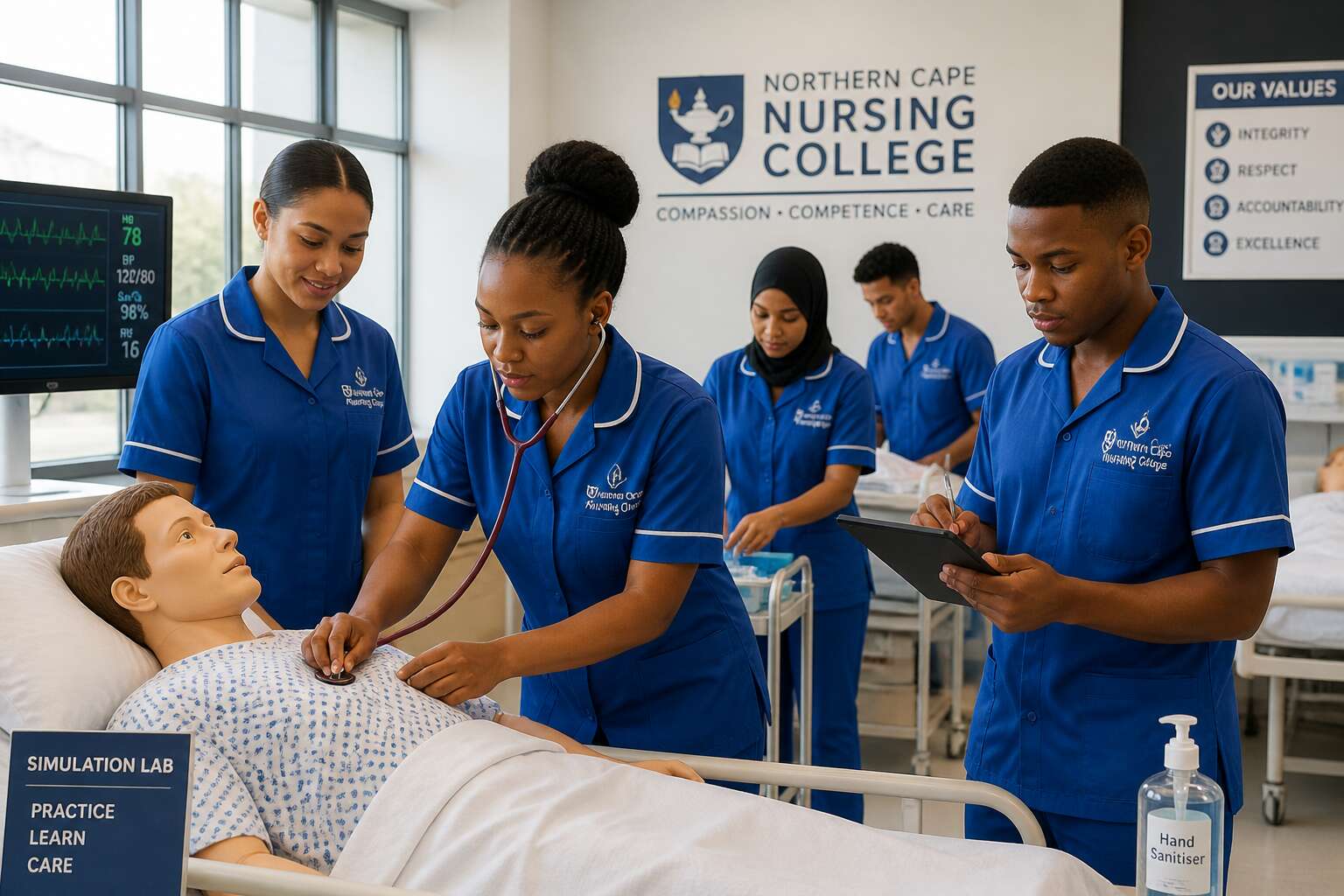
Campus facilities match the demands of the curriculum. Residences sit close to lecture halls, which helps when you have a 7am ward start. The skills laboratory stays open late. Students practise on mannequins while the library hums with quiet study. Every corridor leads somewhere useful.
Accommodation at Northern Cape Nursing College includes:
- Single and shared rooms with study desks
- Communal kitchens and laundry areas
- 24-hour security and resident wardens
A room that locks and a bed that rests seem simple. They matter more than you think when you are training to save lives.
Student Mentorship and Tutoring
Nursing students discover early that the most useful lessons are rarely written on a whiteboard. At northern cape nursing college, a senior student demonstrating a suture knot while you both queue for coffee carries more weight than any lecture slide.
Mentorship is structured as well. Every first year is paired with a senior peer who knows the shortcuts, the quiet study spots, and the correct way to address a ward sister. Weekly tutoring sessions cover anatomy and pharmacology. Attendance is encouraged, not enforced. That distinction shapes the culture.
- Peer mentors hold office hours every Tuesday
- Tutoring groups cap at eight students
- Mentors receive formal training in active listening
The social code is notable. Nobody boasts about failing. Nobody hides it either. Students at northern cape nursing college treat struggle as ordinary business, and that honesty makes every corridor a place where help is expected.
Extracurricular and Professional Organisations
Student life at northern cape nursing college thrives beyond the lecture hall. The campus hosts a lively scene of clubs and professional bodies. The South African Nursing Society chapter runs guest speaker evenings. A student committee arranges community health drives in surrounding villages. First year students often join the peer support circle, which organises weekend hikes and study retreats. Membership in these organisations counts toward professional development hours. Some are quiet, some are loud, all are optional. That freedom matters.
- Student representative council liaises with college management
- First aid response club trains for real emergencies
- Cultural society celebrates the region’s languages and traditions
Students describe the campus as a place where corridors carry conversations about wound care and weekend plans in equal measure. For those who want leadership experience, the nursing student association provides committee roles. These groups shape the character of northern cape nursing college as much as any lecture does.
Wellness and Mental Health Services
The first year of nursing training rearranges your sense of self. Students at northern cape nursing college speak openly about the emotional weight of clinical rotations. The college pairs this reality with structured wellness support. A campus counselling office offers free sessions with registered psychologists. Peer debriefing groups meet monthly to process difficult cases. The student wellness coordinator runs stress management workshops during exam periods.
Support services include:
– A 24 hour crisis line for students in distress
– A quiet reflection room in the student centre
– Monthly mindfulness sessions with a trained facilitator
Sleep, nutrition and exercise are discussed during orientation. Lecturers check in on students who miss multiple classes. Northern cape nursing college understands that a competent nurse emerges from a supported one. That belief shapes every wellness initiative on campus. Students carry this resilience into the wards, where calm minds make the clearest decisions.
Alumni Network and Career Services
Life at northern cape nursing college settles into a rhythm that surprises most first years. Mornings begin with handover reports, afternoons with simulation practice, and evenings with group study. Between these blocks, students build friendships that carry them through difficult rotations. Those bonds often become professional lifelines.
The alumni network keeps those connections alive. Graduates return for guest lectures, host shadowing days at their facilities, and circulate job openings through the college portal. Career services staff meet individually with final year students, reviewing portfolios and preparing them for public hospital interviews.
- Annual alumni dinner and networking evening
- Vacancy alerts for qualified nurses
- Mentorship matching with graduates in your specialisation
Many graduates stay linked to northern cape nursing college long after registration. That ongoing relationship gives students a direct line to the profession, maintained by people who understand the regional health landscape.



0 Comments