
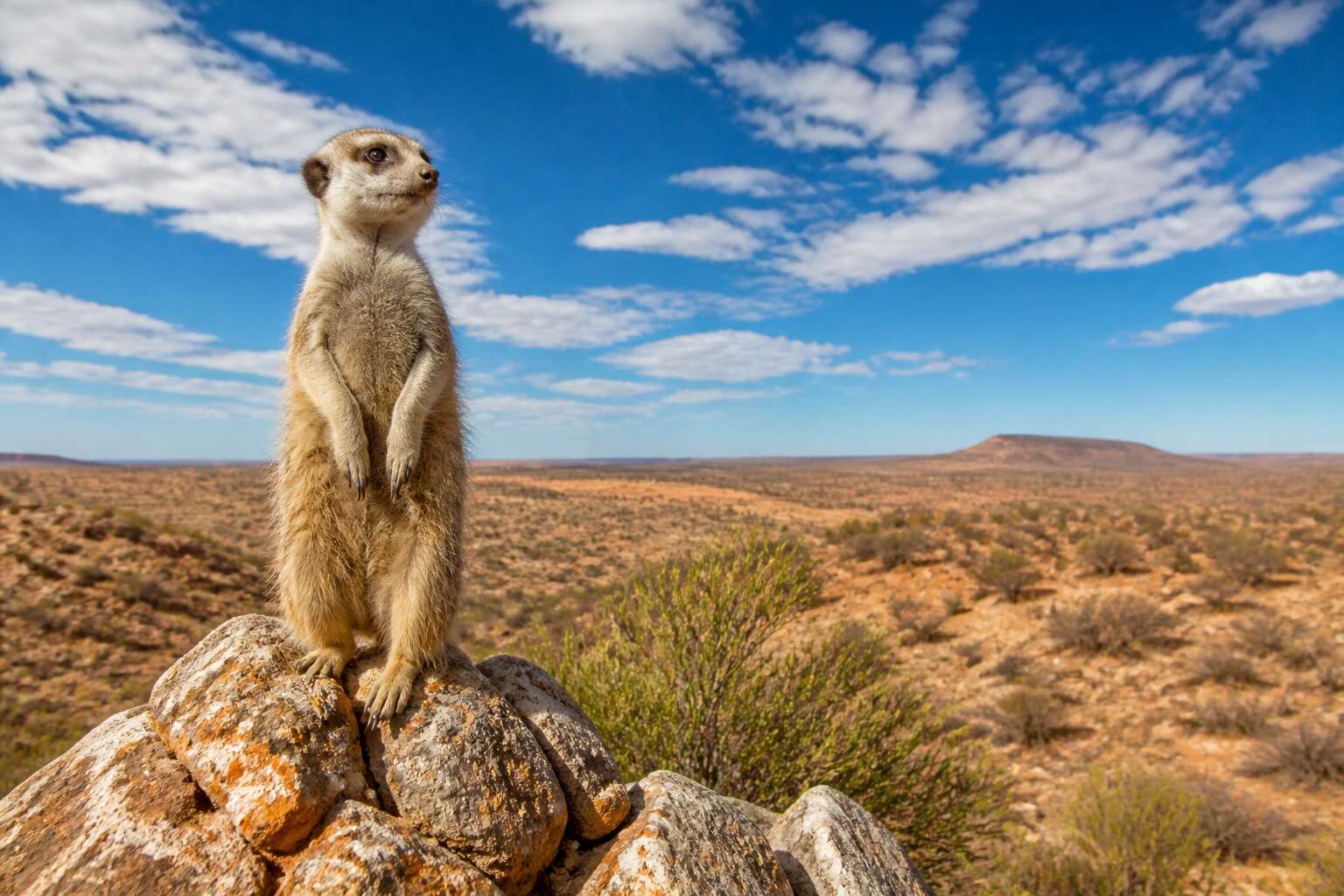
The Unique World of Meerkats
Meerkat Anatomy and Social Structure
Meerkats in the meerkat northern cape spend up to eight hours a day on sentry duty, a commitment that often outlasts human work shifts. I have observed these animals pause mid-forage, their dark eye patches absorbing the brutal sun, while their fusiform bodies dissipate heat with remarkable efficiency.
Their social machinery is equally precise. A mob of thirty individuals operates like a single organism, with the alpha pair holding exclusive breeding rights. Subordinates rotate through essential tasks:
- Sentinels climb termite mounds to scan for raptors
- Helpers dig boltholes and defend the perimeter
- Educators teach pups to handle scorpions
Anatomy supports this hierarchy. Four clawed digits on each foot allow rapid excavation of tunnels, while a recessive dark stripe reduces glare, ensuring every guard remains focused. This is survival, not sentiment!
Daily Life in a Meerkat Mob
The meerkat northern cape morning begins with a collective shudder, bodies emerging from burrows after a fitful night below. Each day follows a rhythm dictated by the sun. The mob disperses across the hardpan, scratching through gravel for beetles and buried roots.
Some days the ground yields nothing. Other days, a single termite mound becomes a feast. The mob moves as one, stopping, listening, tasting the air for shifts in the wind.
- Foraging parties rotate through the territory in deliberate sweeps
- Elders demonstrate digging techniques to the young
- The midday heat forces everyone below ground, a necessary retreat
By late afternoon, the mob resurfaces, driven by hunger and the quiet desperation of survival.
Diet and Foraging Patterns
Each meerkat northern cape mob consumes several tonnes of invertebrates every year. That statistic sounds impressive until you realize they burn most of that energy chasing prey across the Kalahari’s unforgiving crust, which explains why food is always the priority.
Their immunity to scorpion venom is legendary; so is their hunting technique! The diet spans spiders, beetles, millipedes, small rodents, and eggs. The mob fans out, heads down, noses twitching, and solves each meal’s defenses with brutal efficiency:
- Scorpions are pinned and their stingers bitten off first
- Thick-shelled beetles are rolled on the ground to crack the carapace
- Dangerous snakes are mobbed cooperatively until they flee
Food sharing only happens for the very young or the very old. Everyone else eats what they catch. Meerkat northern cape discipline is brutal. The penalty for stealing: a swift nip and a lecture from the dominant female.
Communication and Survival Tactics
A meerkat northern cape mob runs on a sophisticated vocal system. Each trill, growl, and bark carries distinct meaning. Sentinel duty rotates through the group, and the lookout uses different alarm calls for aerial versus ground predators. The response is immediate: a raptor overhead sends everyone diving into burrows, while a snake call triggers a cautious mobbing formation.
Heat presents another survival challenge. During peak Kalahari temperatures, meerkats flatten themselves against shaded earth to draw warmth from their bodies. At night, the mob huddles into a single furry mass, reducing heat loss by up to one third.
- Pups learn adult vocalizations within weeks, fine-tuning each call through play
- Sunbathing after cold mornings raises body temperature without wasting energy
- Dominant females use specific growls to discipline without physical conflict
Each vocal cue and posture works in concert, keeping the meerkat northern cape mob alert and cohesive across a landscape that punishes hesitation.
Planning Your Meerkat Adventure in the Northern Cape
Choosing the Right Time to Visit
If you arrive at a meerkat northern cape site by noon, you have missed the show. These animals operate on a strict schedule, and summer heat turns even the most enthusiastic mob into snoozing silhouettes by ten. I learned this the hard way.
Choosing the right time hinges on daylight and temperature. Winter is practical, with crisp mornings that keep meerkats active for hours. Summer demands an unholy early start, but rewards you with pups and fresh foraging energy. For the meerkat northern cape experience, target June to August or a daring pre-dawn December outing.
- Winter: calm, long windows
- Summer: lively, arrive early
- Shoulder: unpredictable, layer up
The real trick is to sit downwind, stay quiet, and let the mob decide you are uninteresting. That is when the mob reveals its personality. Go with the season, not the forecast, and you will leave with more.
Top Destinations for Wild Meerkats
Somewhere near Kuruman, a meerkat northern cape mob wakes before sunrise, unaware that your entire holiday hinges on their mood. Planning a proper adventure means committing to a specific stretch of Kalahari sand or thornveld. The region holds several reliable territories, and each behaves differently.
- The sparse dunes around Van Zylsrus, where mobs spread wide while foraging.
- The Ghaap Plateau, where juveniles stage mock sentry drills.
- Private reserves near Tswalu, where habituated groups allow close, quiet viewing.
Trackers and wildlife guides hold the real intelligence. They locate roosting sites the previous evening and position you downwind before dawn. For a worthwhile meerkat northern cape outing, book with a lodge running a dedicated meerkat programme. Such guides know each mob’s lineage, rivalries, and daily quirks. Your job is simply to sit still and watch.
Guided Tours vs. Self-Drive Safari
Choosing between a guided excursion and a self-drive safari shapes your entire meerkat northern cape encounter. Guided tours are the pragmatic choice for most visitors, particularly those unfamiliar with the region. Lodge trackers know where each mob slept the previous evening, so the morning search is efficient. They also manage the legalities of traversing private land, which matters greatly here.
- Self-drive demands early starts and serious map reading.
- Public roads skirt some territories, but viewing distances remain long.
- Private reserves typically restrict entry to booked guests.
If you prefer independence, a self-drive meerkat northern cape trip is possible near Van Zylsrus, where dunes are open and traffic is scarce. Yet you must locate the mob yourself and keep a respectful distance. A guide removes that uncertainty, leaving you free to watch the morning unfold.
What to Expect on a Meerkat Encounter
Sunrise in the Kalahari does not announce itself. One moment the sky is a pale film, the next a meerkat northern cape mob tips out of its burrow and the sand begins to move. Planning for the encounter is simple: choose a base close to the territory, rise before first light, and give the guides room to work.
The encounter itself asks for patience. Watch one individual take the sentinel post while the rest turn towards the warmth. A typical morning gives you:
– the sentinel’s shift rotation every few minutes
– foraging sweeps that follow a loose arc across the dunes
– subadults carrying food back to the burrow
None of it happens quickly, but that is the essence. The meerkat northern cape experience repays the unhurried observer.
Accommodation Options Near Hotspots
Nearly every meerkat northern cape safari begins with a night in a place that feels like the edge of the world. The Kalahari’s guest farms and small lodges sit close enough to the burrows that your guide can find the mob before the sun warms the sand.
Choose accommodation that offers early breakfasts and a guide who knows the territory. Most hotspots have a handful of options:
- guest farms with self-catering kitchens
- bed and breakfasts in towns like Van Zylsrus
- wilderness camps with a ranger on call
Some travellers prefer the quiet of a working sheep farm, others want a simple chalet with a kettle. Either way, the meerkat northern cape encounter depends on a short drive to the meeting point, so proximity matters more than luxury.
The Ecological Importance of Meerkats
Meerkats as Keystone Species
A single meerkat mob shifts several tonnes of earth each year. That sounds absurd for such a small creature, yet the payoff is enormous. Their burrowing aerates compacted soil, lets rain reach deep roots, and turns dead ground into fertile patches. In the meerkat northern cape, these effects are impossible to miss.
- Abandoned tunnels become ready homes for aardvarks, snakes, and monitor lizards.
- Excavation brings nutrients to the surface, feeding plants that otherwise starve.
- Constant digging prevents some shrublands from turning into barren hardpan.
This makes meerkats a keystone species, meaning their presence dictates survival for countless others. Eagles, jackals, and even foxes rely on meerkat numbers as prey. Remove the mob, and the whole meerkat northern cape ecosystem shifts toward decline. I have seen collapsed colonies with dusty, lifeless plains. That is the subtle influence of these animals.
Predator-Prey Dynamics in the Kalahari
Every Kalahari morning begins with a series of small decisions, and most are made by animals weighing less than a kilogram. A sentry on a mound must judge the distance of a jackal, the dive speed of an eagle, and the patience of a snake. In the meerkat northern cape region, that judgement is not caution. It is survival!
Predators are not an occasional threat. Martial eagles time attacks to match the first emergence from the burrow. Jackals wait for stragglers on the foraging front. Snakes exploit the one true blind spot: the first seconds after a false alarm. I have seen a mob abandon a productive patch after a single false alarm, and that waste is exactly what keeps the system honest. Every creature pays a price.
Climate Change and Its Impact on the Region
Ecologists studying meerkat northern cape populations are noticing subtle shifts in behavior. Rainfall arrives later each season. Foraging groups travel farther from their burrows to find bulbs and insects. This extra movement does important ecological work.
Meerkats dig thousands of shallow pits while hunting. Those pits trap organic matter and water. Seeds germinate more readily in these micro-depressions. A single mob can process several hectares of Kalahari sand each summer.
Climate models for the region predict fewer, heavier rain events. The effects are visible:
- Later breeding seasons
- Higher pup mortality in drought years
- Increased conflict with neighboring mobs
Each adaptation changes the landscape in turn. The same digging that sustained the Kalahari for millennia may help it absorb the shocks of a warming climate. Watching meerkat northern cape groups reveals how animals shift their habits in response to environmental stress.
Ongoing Research and Study of Meerkat Behavior
Long-term projects such as the Kalahari Meerkat Project have tracked marked individuals for decades. Researchers recognize each animal by facial patterns. Morning weighing sessions reveal how social rank affects growth rates. These records form one of the longest continuous mammal behaviour datasets in Africa.
Ongoing research pairs traditional observation with new technology. GPS collars map foraging routes. Acoustic analysis decodes alarm call variations. Genetic sampling traces lineage through generations. I have watched researchers document a single grooming exchange for over an hour, patience that yields rare data.
Current studies focus on:
- Cooperative pup rearing across family groups
- Hormone fluctuations during dominance shifts
- Survival patterns linked to drought cycles
Each meerkat northern cape mob contributes to a growing picture of adaptation. The data helps ecologists understand how social species respond to environmental change. For visitors, the research adds depth to a wildlife encounter. The meerkat northern cape population offers scientists a rare opportunity to study animal decision making.
Conservation and Community
Threats to Meerkat Populations
A single poisoned bait can wipe out an entire meerkat mob, undoing years of slow reproduction in one afternoon. Conservation efforts across the meerkat northern cape hinge on balancing agricultural expansion with wildlife survival. Farmers often view these animals as competition for grazing, though meerkats actually aerate soil and keep insect populations in check.
The most pressing threats to these communities include:
- Habitat fragmentation from fencing, roads, and mining claims
- Secondary poisoning when pest control operations target rodents
- Domestic dogs that roam unfenced farmland and attack vulnerable pups
Community engagement is essential. Local landowners, working alongside conservation groups, are testing coexistence strategies that reduce conflict without harming livelihoods. Yet funding shortages persist, and awareness of the meerkat northern cape’s ecological role remains limited. The future of these populations depends on whether these collaborative efforts expand before land use intensifies further.
Local Conservation Initiatives
On the ground in the meerkat northern cape, conservation is shifting from protection to partnership. Local ranchers are becoming custodians rather than competitors. A growing network of landowners maintains buffer zones around active burrows, while citizen monitors report mob health through a simple mobile app. This data helps researchers track survival rates without intruding on daily life.
- Rotational grazing plans that leave foraging corridors intact
- Farmer training on non-lethal rodent control
- Joint patrols to remove stray traps and poison bait
What stands out is how much rests on personal conviction. The people who choose to share their land with these animals often speak not of money but of continuity. Their observations, recorded season after season, fill gaps that satellite imagery cannot. The future of the meerkat northern cape hinges on this quiet, stubborn cooperation.
Community Involvement in Wildlife Protection
In the meerkat northern cape, the most influential wildlife protectors rarely wear uniforms. They are lodge cleaners, church elders, and school children. Tourism income has changed local thinking. A farmer who once saw suricates as competition now charges visitors for the privilege of watching them groom each other.
Community meetings now include a meerkat update alongside borehole repairs. One village resolved that no domestic dogs would be allowed near the eastern dune belts.
- A taxi association avoids certain roads during pupping season
- Women’s sewing groups make dolls shaped like meerkats to sell to tourists
- Local teachers embed mob behavior into geography lessons
These actions earn no official awards. But they have reduced burrow disturbance enough that researchers have noticed the difference.
How Tourism Supports Conservation Efforts
The business of watching wild animals dictates the survival of the meerkat northern cape. Tourist revenue provides a financial incentive to preserve these territories, a mechanism far more durable than philanthropic goodwill. Entrance fees from private reserves are often earmarked for habitat maintenance and anti-poaching patrols.
This influx of capital allows researchers to extend their studies beyond core breeding groups. It funds tracking equipment and veterinary care. I have seen a single guided walk pay for a week of data collection, transforming idle curiosity into hard science.
- Vehicle tracks are rerouted to protect dune ecosystems.
- Water points are kept filled during drought.
- Buffer zones are expanded to reduce conflict.
Consequently, the value of a live meerkat now outweighs any perceived nuisance. The meerkat northern cape’s economic vitality is tied to its suricates.
Visitor Tips and Responsible Tourism
Essential Photography Techniques
The Kalahari sun is unforgiving, yet the meerkat northern cape rewards those who arrive early. I position myself before dawn to capture the golden hour as the mob emerges. Keeping my distance lets them settle into their routine. Movement startles them, so stillness is essential.
For essential photography techniques, remember these points:
- Use a telephoto lens to avoid crowding the animals.
- Set your shutter speed above 1/1000s to freeze their quick movements.
- Focus on the eyes, as they carry the expression.
- Lower your camera angle to match their level.
Responsible tourism means your presence never alters their behavior. The meerkat northern cape experience thrives on quiet observation, not intrusion.
Must-Have Gear for the Field
Visiting the meerkat northern cape is a lesson in patience and humility. These animals read the landscape and your intentions with unnerving clarity. Arrive with your expectations tucked away, and let the mob reveal itself to you.
Responsible tourism here means respecting boundaries, both theirs and yours. Never block their burrows, avoid sudden gestures, and keep your voice low. The meerkats will accept your presence, but only if you remain an observer. Scent matters too, so skip strong perfumes and lotions before heading out.
- Carry at least two liters of water per person
- Wear closed shoes with ankle support
- Pack a wide brim hat and sunscreen with high SPF
- Bring binoculars for distant observation
The gear you choose shapes the experience. A lightweight daypack keeps your hands free. A field notebook adds a personal touch, though the meerkat northern cape often offers enough memories without it. Stay quiet, stay present, and the desert will do the rest.
Respecting Animal Welfare
A mob of meerkats in the northern cape reads human behaviour faster than we read theirs. That awareness shapes every responsible encounter. I have watched visitors lose patience and move too close, which only sends the group scurrying. Let them set the pace.
Respecting animal welfare begins with simple restraint. Do not feed them, do not chase them, and do not block their burrow entrances. Watch for signs of stress like wide eyes or defensive postures. If you see these, step back. The guides know the meerkat northern cape and its daily rhythms, so defer to their expertise.
- Maintain a distance of five metres
- Remain standing or crouched, never looming
- Keep voices low and movements slow
Your presence is a privilege, not a right. The meerkat northern cape rewards those who respect its residents.
Safety Precautions in Remote Areas
Remote encounters with the meerkat northern cape demand preparation beyond the trailhead. Cell reception fades quickly, and the sun punishes the unprotected. Carry at least two litres of water per person, a brimmed hat, and a charged power bank before you set out.
Stick with your guide at all times! The Kalahari hides other residents, from scorpions to snakes, and a misplaced step can end the day early. Lock your vehicle and tell someone back at camp your intended route.
- Check tyre pressure before leaving the main road
- Pack a physical map, not just a downloaded one
- Note the nearest emergency evacuation point
These habits keep the focus where it belongs, on the meerkat northern cape and the privilege of watching them rise with the sun.
Cultural Etiquette and Local Customs
The meerkat northern cape rewards travellers who learn the local social graces. A greeting in Tswana or Afrikaans often leads to richer stories about the land. Respect for privacy matters as much as respect for wildlife.
When visiting rural communities around the Kalahari:
- Ask before photographing people or homesteads.
- Accept refreshments with both hands.
- Dress modestly outside tourist lodges.
The Kalahari wind carries voices further than you expect. Keep your tone low near camps and kraals. Your guide is a neighbour, not a servant, so include them in conversations. This place holds its customs close, and visitors who listen gain access to more than a safari. They gain a sense of the daily life that supports the meerkat northern cape.


0 Comments