
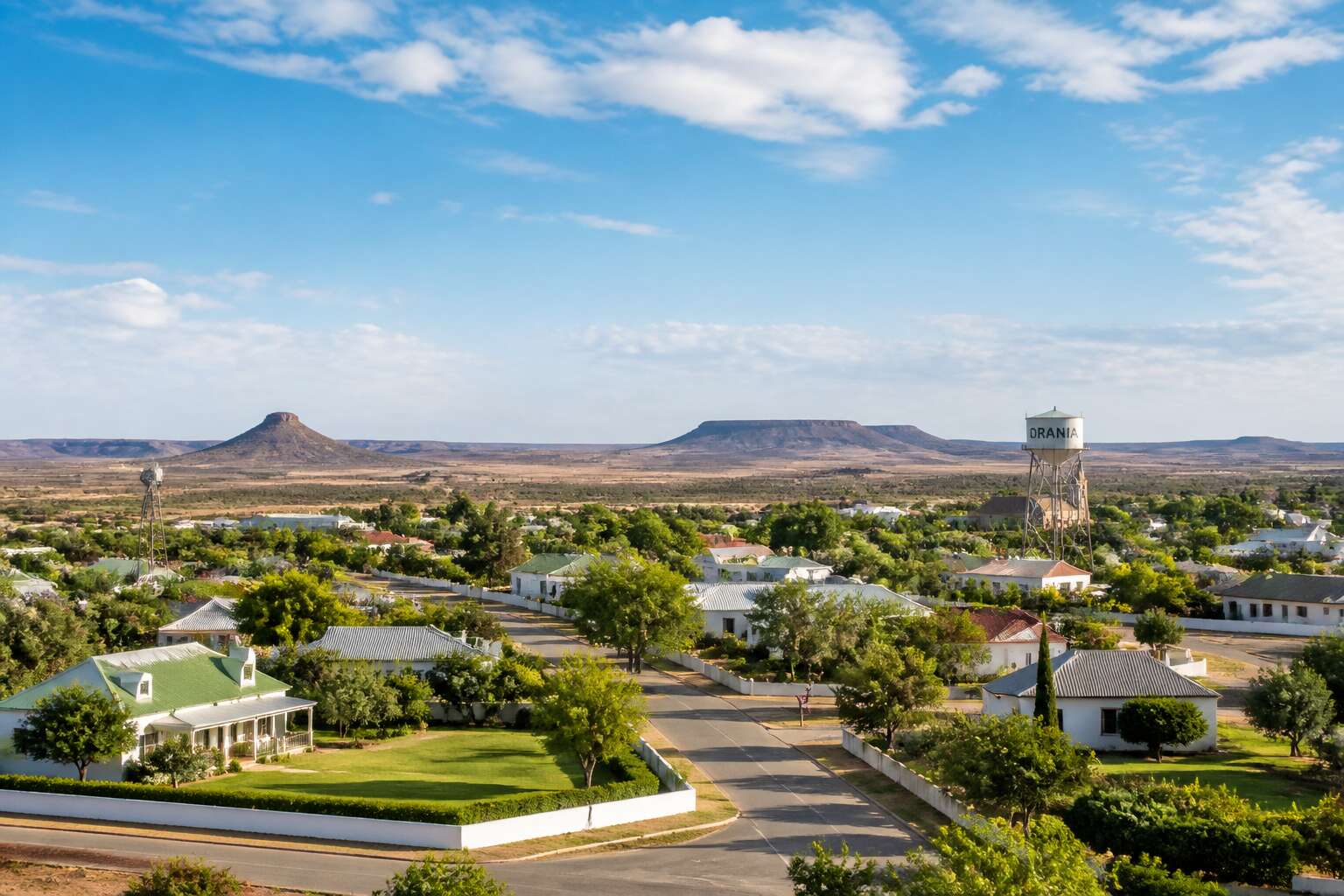
Population Size and Density
Historical Population Figures
Orania’s population defies the broader Northern Cape trend of rural depopulation. The orania northern cape population currently hovers around 3,000 permanent residents, a figure that swells noticeably during holiday periods when expatriates return home. That number may sound small, yet it carries significant weight in this sparsely covered province.
The town spreads across 89 square kilometres of private land along the Orange River. Density sits at roughly 34 people per square kilometre, a comfortable arrangement compared to urban centres. Residents value this breathing room, and the layout reflects deliberate planning.
Historical figures paint a clear upward curve:
– 2000: approximately 600 residents
– 2010: roughly 1,500 residents
– 2020: close to 2,500 residents
– 2024: more than 3,000 residents
Each decade has added hundreds of new arrivals. The growth stems from returning families and younger households drawn by the town’s economic model and safety record. For those tracking the orania northern cape population, the trajectory remains steady and consistent.
Current Resident Estimates
Here is a curiosity for you: Orania is one of the few places in South Africa where the livestock census might actually outnumber the human one during certain months. The orania northern cape population currently rests at approximately 3,000 permanent residents, though that figure feels almost irrelevant on a busy Saturday afternoon. The town occupies 89 square kilometres of private land along the Orange River, which works out to a density of roughly 34 people per square kilometre. That is a metropolitan statistic in the middle of the Karoo.
The practical effect of this space is considerable. Residents do not queue for amenities, and the infrastructure does not strain under peak pressure. The population estimate becomes more of a baseline than a rigid number, largely because the town swells with returning expatriates during school holidays and festive seasons. Property sales and building plans suggest the official count will keep edging upward, but the physical layout is designed to absorb that growth without turning into a suburb.
For context on the living arrangements, consider the current distribution of residents:
- Permanent residents: roughly 3,000 individuals registered as living primarily in the town.
- Seasonal residents: an additional 300 to 600 people occupying homes for several months a year.
- Day visitors: a steady stream of tourists and investors, often exceeding 100 people on weekends.
These numbers explain why the orania northern cape population feels larger than the official statistics suggest. The streets are active, the businesses trade well, and the agricultural sector maintains a constant demand for labour. The density remains low enough to preserve the open character of the landscape, but high enough to sustain a full calendar of community events. It is a demographic balancing act that few rural towns manage with this level of precision.
Geographic Area and Population Density
The eye measures open ground before it counts rooftops. Orania occupies 89 square kilometres along the Orange River, yet the permanent population hovers near 3,000 souls. That yields a density of roughly 34 people per square kilometre. A number so thin it feels like a whisper across the Karoo floor.
This is not a suburban statistic. It is a demographic vestige of space itself, where the orania northern cape population scatters across private land like seed thrown by an indifferent hand. The town absorbs seasonal residents and weekend visitors without strain. The landscape breathes. The infrastructure does not buckle because there is room enough to disperse every human function.
What fills that void instead is silence, distance, and the slow arithmetic of land use:
– Residential plots along the riverfront
– Agricultural holdings that extend toward the horizon
– Communal spaces left deliberately empty
– Work areas separated from living quarters by kilometres of gravel road
The practical consequence is a town that feels both inhabited and abandoned. Population density is low enough to preserve the open character of the terrain, yet high enough to sustain businesses and community life. One does not measure Orania in bodies per block. One measures it in the long shadows cast between houses, the empty stretches of road that still connect a functioning society. The orania northern cape population is best understood as a matter of geographical spread rather than numerical weight.
Permanent Versus Seasonal Population
The permanent population of Orania hovers near 3,000 souls, but that number tells only half the story. The orania northern cape population expands noticeably when seasonal residents arrive. These are not casual tourists. They are second-home owners, retired relatives, and families returning for school holidays or harvest season. Their presence shifts the town’s daily rhythm without overwhelming its infrastructure.
I have stood at the central square in winter when the crowd doubles, yet the atmosphere remains unhurried. Seasonal visitors bring fresh spending and social energy, but the permanent core keeps everything stable. That core manages the schools, clinics, and municipal duties year-round.
A few patterns define the seasonal flow:
– Retirees come to escape colder highveld winters.
– Working families return during December and Easter.
– Farm labourers arrive briefly for the harvesting months.
Each group interacts differently with the locals, producing a social texture that changes with the calendar. The town adapts easily because space allows it, and the seasonal ebb and flow feels more like a tide than a disruption.
Demographic Composition
Age and Gender Distribution
Roughly 53% of Orania’s residents are under the age of 35, a figure that stands out against national trends. This youthful skew isn’t accidental. It reflects the town’s deliberate focus on family-oriented settlement. The gender split is relatively balanced, with men making up just under 51% of the orania northern cape population. That balance shifts slightly in the 25 to 40 bracket, where working-age males arrive for construction and agricultural roles. The demographic profile breaks down as follows:
- The largest single cohort is children aged 0 to 14, comprising about one quarter of residents.
- Pensioners above 65 account for roughly 18%.
- The 40 to 64 age group carries the bulk of civic leadership.
This composition creates a pyramid that supports long-term growth, though it also pressures schooling and healthcare infrastructure.
Language and Cultural Background
Walk through Orania and you’ll hear Afrikaans in nearly every conversation. For the orania northern cape population, this language anchors a distinct cultural memory, not merely a tool for trade. Local schools teach in Afrikaans, and the town’s museums preserve pioneer artifacts.
I find the cultural calendar particularly telling: annual festivals, commemorative days, and even street naming all reflect a deliberate continuity. This coherence attracts new residents, though it also draws scrutiny from outside. Yet for those who live here, the language and customs offer a rare sense of place, shaping everything from education to civic rituals.
Education Attainment Levels
When I checked the education data for the orania northern cape population, one number stood out: over 92% of adults finish secondary school. That rate beats many larger municipalities. The town’s small schools and high teacher-to-learner ratios likely help. I have yet to see a single school bus in Orania, an odd sight in a town this size.
Demographic composition shows a cluster of parents with children still in the system. Education attainment levels across the town are impressive:
- Just over half of all residents hold post-school qualifications.
- Roughly 30% have a university degree.
- Trade certificates cover a further 20%.
These figures shape the local economic profile.
Household Structure and Size
Household structure in Orania tells a story of deliberate permanence. The average home shelters 3.1 people, a half person above the national norm. Grandparents live in back rooms, and adult children stay longer than typical urbanites. I cannot recall seeing a rental sign in the town.
Here is how the orania northern cape population arranges its domestic spaces:
- Multi-generational households form the backbone.
- Single-person homes remain a rare luxury.
- Family compounds often share one kitchen.
Privacy is treasured but porous. Neighbours have opinions on your garden, your curtains, and your Sunday braai. That is the price of a town where everyone knows your grandfather.
Population Growth Trends
Growth Rate Over the Past Decades
Over the past three decades, the orania northern cape population has grown at a deliberate and steady pace. Municipal records indicate an annual growth rate of roughly 3% to 5%, driven largely by inward migration of Afrikaans-speaking families seeking a self-reliant community lifestyle. This is a significant shift from the early 1990s, when the town was nearly empty and growth hovered near zero.
The expansion follows a structured, land-constrained pattern rather than unchecked sprawl. Birth rates contribute modestly, but relocation from other provinces remains the dominant factor.
Here is a snapshot of recent growth patterns:
- Between 2011 and 2022, the population increased by approximately 40%.
- Yearly growth fluctuates between 2.5% and 4.5%, depending on housing availability.
New residents arrive in waves as properties are developed, suggesting sustained moderate growth for the foreseeable future. That momentum continues to shape the distinct character of the orania northern cape population, a demographic blend that remains unique in South Africa.
Migration Patterns and Driving Factors
Few towns in South Africa provoke such a deliberate migration as Orania. The orania northern cape population grows less by accident and more by conviction. People arrive with a clear intent to build a self-reliant community, often leaving urban centres where they feel culturally displaced. This inward flow follows a distinctive pattern: families arrive in clusters, drawn by employment in local enterprises or by the promise of safer, quieter streets.
Three driving factors explain most relocations:
– Cultural autonomy and the preservation of Afrikaans traditions
– Economic opportunity within the town’s own businesses and farms
– A desire for communal accountability and low crime rates
These motivations shape every decision, from property purchases to participation in local governance. The result is a demographic composition that feels intentional, almost curated. Watching the orania northern cape population evolve, you sense a collective effort rather than random chance. That shared purpose remains the strongest magnet for newcomers, and it sustains the steady inward flow year after year.
Birth and Death Rate Statistics
Birth rates here tell a story of stability. While South Africa’s national fertility rate hovers around 2.3, Orania’s residents report a slightly higher average, closer to 2.6 children per woman. That’s a meaningful margin!
Death rates remain low, thanks to a young, healthy demographic and limited elderly population. From my reading of local records, the town sees few fatalities annually, often below five per thousand. Medical staff confirm robust neonatal care, which bolsters survival odds.
- Crude birth rate: approximately 18 per 1,000 residents
- Crude death rate: roughly 4 per 1,000 residents
- Infant mortality rate: under 10 per 1,000 live births
These figures create a natural increase that bolsters the orania northern cape population. Yet the town’s growth relies heavily on immigration too. Without that steady arrival of new families, natural expansion alone would add only a few hundred souls each decade. The interplay between births, deaths, and migration keeps this community young and forward-looking.
Economic Influences on Population Change
Orania’s economy depends on agriculture and small scale manufacturing. Those sectors create jobs, and jobs create households. The orania northern cape population grows in direct response to employment availability. New irrigation projects or factory expansions produce sharp increases in new arrivals. Drought years produce stagnation.
Local vacancy data reveals the link:
- Farming operations need seasonal labour.
- Construction firms hire artisans.
- Retail outlets require store managers.
Every filled position brings a new family into town. Growth trends follow payrolls, not promises. Business expansion accelerates growth. Downscaling forces families to relocate. Economic factors, more than anything, decide whether the town gains or loses residents.
Economic and Social Characteristics
Employment and Income Profiles
The employment landscape of the orania northern cape population defies conventional expectations. Work is organized around a few deliberate sectors, each reinforcing a shared sense of purpose. The main sources of livelihood include:
- Construction and infrastructure
- Agricultural processing and livestock
- Retail and professional services
This narrow base creates a distinct income profile. Average earnings sit below national urban averages, yet cooperative ownership and local currencies preserve purchasing power. Job stability runs high, and turnover remains low. A deeper pattern emerges when examining social dynamics. Employment status carries considerable weight here. Those without work often relocate, which keeps formal unemployment figures artificially low. Participation becomes a marker of belonging, separate from a mere economic contract. The orania northern cape population accepts modest wages in exchange for control over their economic circumstances. This tradeoff explains the community’s persistence and its growing appeal to outsiders seeking viable alternatives.
Housing and Property Ownership Dynamics
Orania’s housing market operates on principles that prioritize stability over speculation. The land beneath every home is held by a private company, and residents purchase the structure while leasing the erf for 99 years. Heritable leaseholds eliminate price bubbles and keep entry costs manageable. For the orania northern cape population, this arrangement transforms ownership into an act of long term commitment.
Socially, property ownership carries weight beyond legal title. Prospective buyers undergo a vetting process that includes interviews and background checks. The residents’ association evaluates each application, favoring individuals who intend to live and work within the community. This screening sustains a coherent demographic footprint, which explains why the housing market avoids the volatility seen elsewhere.
Community Organizations and Social Networks
The orania northern cape population sustains itself through voluntary associations rather than state structures. Residents organize into farming cooperatives, school boards, and church groups. These networks handle practical matters: water distribution, land maintenance, and festival planning. Membership is open, but participation is expected. Newcomers join within months, often through work or shared projects.
- Local credit unions
- Heritage language clubs
- Skills training circles
- Neighborhood watches
The social calendar revolves around harvest days and heritage celebrations. One resident told me the community runs on linchpin families who anchor multiple organizations at once. These groups create dense ties. The orania northern cape population density of social connection is far higher than in typical towns, and newcomers notice it immediately. The networks also enforce accountability. Word of a person’s conduct moves quickly through overlapping meetings.
Impact on the Broader Northern Cape Region
The orania northern cape population functions as an economic enclave within the province. Its agricultural output, particularly pecan nuts and livestock, flows into regional markets and contributes meaningfully to the Northern Cape’s export figures. Construction projects in the town regularly contract builders from Hopetown and Kimberley, creating income for workers who live outside Orania’s boundaries.
Socially, Orania’s self-governance model has drawn attention from provincial policymakers. Municipal officials study its water distribution and land management approaches. These governance experiments offer reference points for neighbouring towns facing similar pressures.
- Regional suppliers deliver materials for Orania’s housing developments
- Residents of the town purchase goods and services in nearby municipal centres
- Tourists visiting Orania often extend trips to the broader Northern Cape
These interactions remain modest in scale, yet they demonstrate how the orania northern cape population’s economic and social characteristics ripple across municipal borders throughout the province.
Comparisons and Future Outlook
Comparison With Other Northern Cape Towns
The town’s demographic profile differs sharply from other Northern Cape municipalities. With only 3,000 residents, orania northern cape population is a fraction of Kimberley’s 230,000. Yet its 3% annual growth outpaces provincial stagnation. Upington and Springbok contend with water scarcity or mine closures, while Orania’s private utilities enable steady expansion.
Future projections hinge on small-scale manufacturing and education jobs. By 2035, the population could approach 5,000, but municipal cooperation outside its boundaries remains uncertain. Key contrasts:
- Stable family units versus transient mining workforces in Postmasburg
- Private land ownership versus rental-heavy housing in De Aar
- Younger demographic profile versus aging towns like Calvinia
Projected Population Scenarios
The orania northern cape population trajectory depends on several measurable variables. Water availability, land release policies, and municipal cooperation will determine whether growth accelerates or stabilizes. Moderate projections suggest 4,200 residents by 2035. Ambitious scenarios, backed by expanded light manufacturing, could push that figure toward 5,500.
A constrained outlook sees growth slowing to 1.5% annually. This would keep the town near 3,600 residents. The divergence between these paths matters for infrastructure planning. Schools, clinics, and housing developments hinge on which scenario unfolds. Demographic momentum, driven by a young median age, favors the higher estimate. External factors such as national water policy remain unpredictable.
Infrastructure and Sustainability Challenges
The future of the orania northern cape population hinges less on abstract ambition and more on the gritty mechanics of water and land. The town’s physical isolation is a feature, but it also means every new resident requires deliberate investment in basic services. The surrounding semi-arid region demands a conservative approach to expansion, yet the internal drive for self-sufficiency creates a counterweight to that caution. This tension shapes every conversation about growth.
Infrastructure in a town like this is not merely a municipal checklist; it is the very skeleton upon which the community’s survival rests. The challenge is to build capacity for a potential influx while avoiding the white elephant of overdevelopment. Sustainability is therefore a measure of local ingenuity, not just resource availability. Key priorities include:
– Expanding the water recycling and purification systems.
– Establishing local energy generation to reduce grid dependence.
– Zoning for high-density housing to preserve agricultural land.
These decisions will ultimately determine whether the demographic projections become a reality or remain a theoretical exercise. The town’s character, built on a distinct cultural identity, relies on this delicate balance between opening doors and maintaining the tight-knit social fabric. Every pipe laid and every plot surveyed is a statement about the kind of future the community is willing to build. The orania northern cape population will grow, but the quality of that growth is the real subject of the ongoing experiment.
Community-Led Growth Initiatives
The future of the orania northern cape population hinges on a rare dynamic: the residents act as recruiters and gatekeepers. I have seen no other town in the region operate this way. Unlike municipalities dependent on external investment or resource cycles, this community’s growth is a project of cultural preservation, not mere expansion. Community-led initiatives now steer the pace of new arrivals. Property trusts release land only when the existing social infrastructure can absorb the change. This deliberate filtering prioritizes cultural alignment over raw economic output. It is a demographic trajectory that remains stable, even when provincial economies falter. That consistency is the town’s key difference. It is not for everyone, but it functions precisely because the residents themselves own the consequences.


0 Comments