
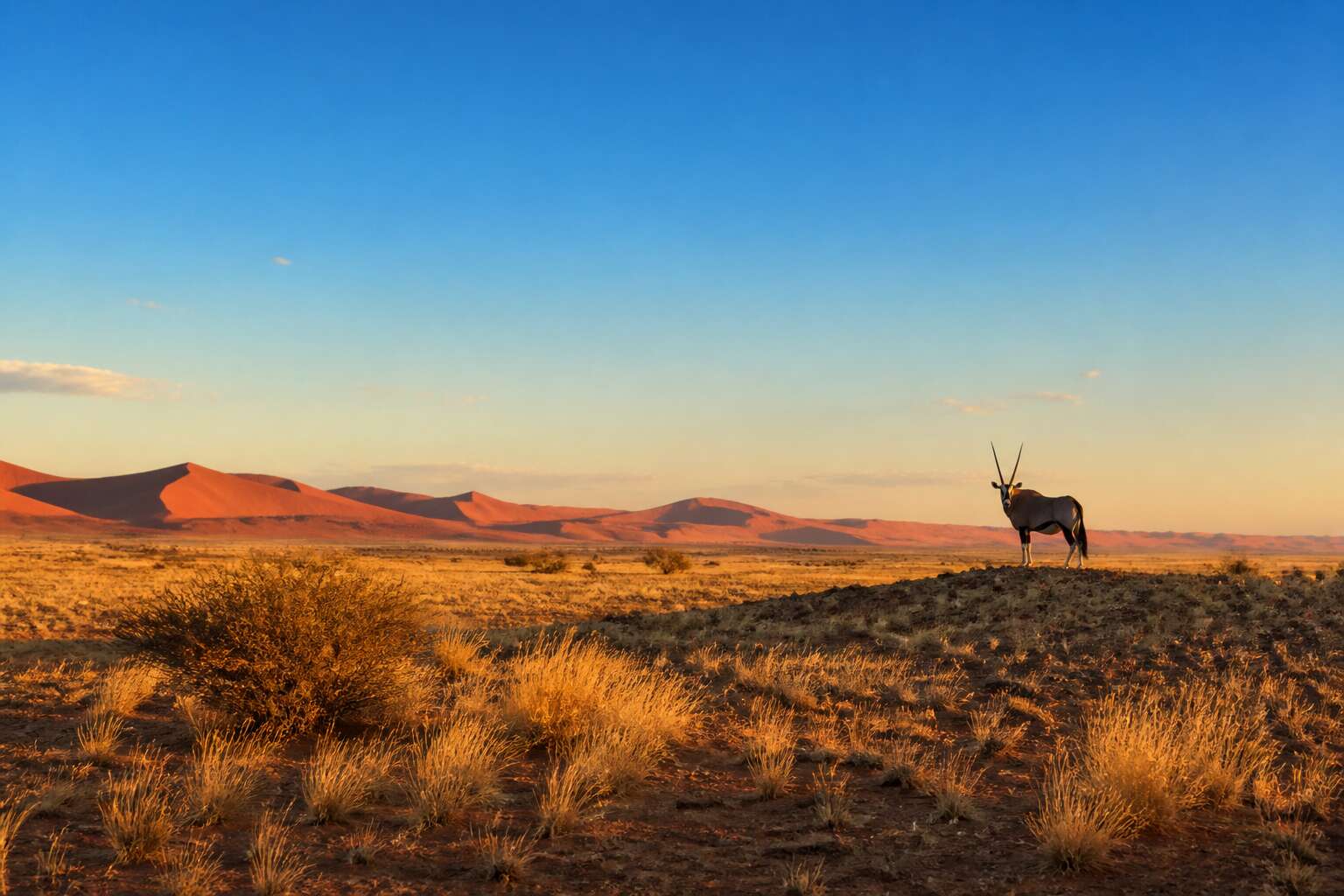
The Untamed Beauty of the Northern Cape
Geography and Landscape
Here, the earth reveals a raw honesty that few places in South Africa dare to show. The Northern Cape sprawls across ancient rock, volcanic vents, and sweeping Kalahari sand. This is a land of silence, where the Orange River carves a lifeline through the parched wilderness. The terrain unfolds as a palette of rust, ochre, and pale gold. The defining landscapes include:
– The endless red dunes of the Kgalagadi
– The lunar rock formations of the Richtersveld
– The dramatic gorges around Augrabies Falls
– The wildflowers of Namaqualand in spring
Water sluices over the Augrabies waterfall, thunder trapped in the arid plateau. The northern cape national parks each reveal this unique topography, yet they safeguard the fragile ecosystems that thrive in these harsh conditions. The geography shapes every species and vista.
Climate and Seasonal Highlights
South Africans love to complain about the weather, but the Northern Cape actually delivers drama in every season. The mercury here doesn’t mess around. Summer days in the Kalahari can push past 40°C, while winter nights often plunge below freezing. That kind of temperature swing defines the character of the region. It also dictates when you should visit the northern cape national parks.
The rainy season transforms the arid landscape in ways that surprise first timers. When the summer thunderstorms roll in, the Kgalagadi’s red dunes turn lush and green. Predators follow the herds, and birdwatchers get their fill of migrants. But the real showstopper arrives in spring. The Namaqualand wildflower bloom is a brief, explosive event that paints the desert floor in oranges, purples, and whites. It is a natural spectacle that draws photographers from across the globe.
Winter offers a different set of advantages. The cooler temperatures make game viewing more comfortable and more productive, since animals stay active throughout the day. The stark, barren landscapes get a crisp clarity under the winter sun. Each season in the northern cape national parks offers a distinct flavour, so there is no single best time, only the right time for your preferences.
Conservation and Community Impact
Conservation in the Northern Cape is a community affair. The northern cape national parks have moved away from exclusionary policies and now hire local people for critical work. Rangers, trackers, and maintenance crews come from surrounding towns. This creates reliable income in areas where formal employment is scarce.
Community oversight also changes how decisions get made. When local leaders have a say in park management, they push for practices that protect water sources and grazing land. The result is a system where both wildlife and people share the risks and rewards. That alignment makes the parks more resilient, and it gives residents a genuine stake in the land’s long term health.
Must-Visit Parks and Reserves
Kgalagadi Transfrontier Park
Kgalagadi Transfrontier Park is the arid heart of the northern cape national parks, a stark wilderness where the red dunes meet a bleached sky. This vast expanse is larger than Switzerland, yet its silence is profound. Here, the Kalahari’s ancient sands tell stories written in the spoor of oryx and the shadows of acacia trees. The dry riverbeds of the Nossob and Auob are the lifelines, drawing in an astonishing array of wildlife to their sparse waterholes.
This is not a place of abundance but of adaptation. The predators here are master strategists, and the black-maned lions are its undisputed sovereigns. Cheetahs stalk the grassy pans with breathtaking speed, while leopards melt into the branch of a camel thorn. The park is a sanctuary for birds of prey, with the martial eagle and the pale chanting goshawk surveying their vast territory from on high.
– The famous Kgalagadi big cats, particularly the black-maned Kalahari lion
– Herds of gemsbok and springbok that navigate the dune sea with astonishing efficiency
– The red sands and starkly beautiful camel thorn forests that define the landscape
A journey into this remote realm is a raw, unfiltered encounter with nature. The isolation is a feature, not a flaw, offering a chance to witness a ecosystem working precisely as it should. For those seeking a genuine wilderness experience within the northern cape national parks, the Kgalagadi remains the definitive, untamed benchmark.
Namaqua National Park
Roughly 1,000 plant species are recorded within Namaqua National Park’s boundaries, placing this reserve at the forefront of botanical conservation. A functional member of the northern cape national parks, it protects the Succulent Karoo biome. The Skilpad section is the epicentre of the spring bloom, when daisies and gousblom colour the plains with an intensity that draws global attention.
- Strandveld and skilpad floral zones that bloom independently
- Granite koppies scattered with quiver trees and halfmens
- An unfenced coastline where gemsbok graze beside the Atlantic
The botanical character extends to the coast, where the park meets the cold Atlantic. Tidal pools harbour marine life while endemic reptiles patrol the dunes. The convergence of desert ecology and maritime influence makes this park singular, and those who linger beyond flower season will find a quieter narrative.
Mokala National Park
Mokala National Park operates as the quiet counterpoint among the northern cape national parks. While its siblings trade in desert extremes, Mokala offers acacia woodland and open grassland near Kimberley. This reserve built its reputation on endangered species breeding rather than dramatic scenery.
The park’s treasures include a disease-free buffalo herd, tsessebe, and roan antelope. Because large predators are absent, game viewing feels refreshingly unhurried. You might share a waterhole with a kudu and not see another vehicle for hours. Consider what makes this reserve distinctive:
- Acacia and silver cluster-leaf woodland that turns golden at dusk
- Rare tsessebe and roan antelope populations thriving on protected plains
- Guided night drives revealing the lesser-known nocturnal residents
You can wander the reconstructed frontier town of Mosu or watch elephants from the veranda at Lilydale Lodge. The landscape stays gentle, the wildlife generous, and the crowds notably absent. That remains Mokala’s greatest charm: an intimate safari experience in a province better known for dunes and daisies.
Augrabies Falls National Park
For raw drama, few places in the northern cape national parks rival Augrabies Falls. Here, the Orange River narrows before plunging 56 meters into a granite gorge. The thunder of the water is constant, a deep vibration felt through your boots as you walk the rim paths. Summer rains transform the falls into a furious torrent, but even in the dry months, the sheer scale of the canyon commands attention.
The park’s lunar landscape, carved from ancient Namaqualand granite, holds a stark beauty. You can hike the Dassie Nature Trail or drive to the Oranjekom viewpoint for a panorama of the ravine below.
– Look for the resident klipspringer and the elusive leopard that patrol these rocky cliffs.
– Visit the Moonrock, a massive exfoliation dome sunset, when the stone glows orange.
The isolation here feels complete. It is a different kind of safari, one defined by geology and the persistent voice of falling water, a testament to the raw power shaping this corner of the Northern Cape.
Wildlife Encounters and Natural Wonders
Predators of the Arid Regions
Whisper this quietly, but the arid regions of the northern cape national parks do not need lush rivers to stage a drama. Here, a black-maned lion’s roar travels seven kilometers across cracked earth, a sound that rearranges your thoughts. These predators operate on a currency of scarce calories. A leopard will haul a springbok carcass twenty meters up a cliff face, not for theatrics but because brown hyenas have no manners.
What fascinates me is the timing. Cheetahs hunt only when the sun softens, using the dark to mask their final sprint. Spotted hyenas coordinate like a street gang with a map, while the small stuff, such as aardwolves, lick up termites in a few hours to avoid the heat. The northern cape national parks force every predator to become a strategist, from the caracal stalking a dassie to the Cape fox investigating a dung heap.
- Lions here skip the pride routine, forming coalitions of just two or three
- Leopards cache prey in quiver trees to dodge vultures and heat
- Genets and servals exploit rocky koppies that remain cool after sundown
These encounters rarely end in a blur of action. Instead, you wait. A jackal flicks an ear, and the whole hierarchy shifts. The natural wonder lies in how these animals read the land, its moisture, its shadows, and the exact second a despairing springbok drops its guard.
Migratory Birds and Endemic Species
One hundred and twenty bird species can appear in a single northern cape national park during the wet season. The migrants arrive without ceremony, their arrival linked to rainfall patterns far north. I have seen the red-backed shrike perch on a shepherd’s tree, recovering from a journey across the equator.
Endemic species offer a different reward. The Sclater’s lark and the red lark occur nowhere else on Earth. You find them by tracking their calls across calcrete flats. The trick is staying still. The birds accept your presence, then resume their business.
- Cinnamon-breasted warbler in rocky gullies
- Layard’s tit-babbler in acacia thickets
- Barlow’s lark near the Namibian border
The northern cape national parks reward patience over speed. A single waterhole can host a migration of birds and a resident endemic in the same hour.
Desert Flora and Quiver Trees
The quiver tree survives for centuries in the northern cape national parks. Some specimens exceed 300 years, their hollowed branches once used by San peoples to carry arrows. A fine white powder coats the bark and reflects the sun. The tree drops leaves in drought, losing parts of itself to protect the whole.
Desert flora follows a slower rhythm. The kokerboom stores water in its trunk. The camel thorn drives roots thirty metres down.
- Quiver trees flower in June and July, drawing sunbirds to their nectar
- Namaqua fig seeds settle into granite cracks and endure decades of wind
- Wild cucumber vines shelter under the shade of larger shrubs
Wildlife encounters in the northern cape national parks begin with these quiet interactions. The bat-eared fox turns soil for insects. The ground squirrel stands sentinel. You notice the gecko on the bark before you notice the sky.
Waterfalls, Canyons, and Rock Formations
The canyon floors of the northern cape national parks hide a secret rhythm. Rock art fades into sandstone walls, older than any living memory. Seasonal waterfalls, like those near the Ghaap Plateau, erupt only after cyclonic rain, then retreat into cracks for years.
Wildlife encounters here favor the watchful. A rock monitor slips under a ledge. A Verreaux’s eagle scans the void. You might hear the sharp whistle of a hyrax before you ever see it.
- Stromatolite fossils layered in ancient limestone
- Dolerite ridges that channel rare floodwater
- The Van Zyl’s Pass, a steep descent into the riverbed
Water carves, wind polishes, time leaves the rest. These northern cape national parks reward those who wait for the waterfall’s fleeting voice and the canyon’s long answer.
Night Skies and Stargazing
Twilight in the northern cape national parks does not end the day so much as it changes the cast of characters. While the big predators retreat from sight, the smaller voices take over. A barking gecko answers the rustle of a Cape fox. The ground between dolerite boulders reveals the polished trails of scorpions, and the air carries the low, thrumming wingbeat of a nightjar on its hunt.
The sky above these parks deserves its own patience. With little artificial light, the Milky Way emerges as a dense river of stars, and the Large and Small Magellanic Clouds hover like faint companions. This is a place where the dark itself becomes a landmark.
- The satellite passes etch slow arcs across the void
- Planet trails, like Venus and Mars, hold their glow near the horizon
For any visitor, the reward is a kind of double exposure: one part earthbound wildlife, one part cosmic depth, each feeding the other in the silence of the Karoo night.
Planning Your Adventure
How to Get Around
Three million hectares is a number that defies the human grasp of scale, yet that is the vast expanse of wilderness that constitutes the northern cape national parks. The sheer magnitude of this region means that planning isn’t just a matter of booking a bed, it is an exercise in logistics and spatial awareness. You are not planning a visit to a reserve; you are planning an expedition across a landscape that operates on its own timetables.
Distances in the Northern Cape challenge your perception of travel. A perceived two-hour drive quickly becomes a four-hour engagement with the horizon. This truth demands you consider your method of conveyance with the seriousness it deserves. The journey between the arid dunes of the Kgalagadi and the verdant oasis of Augrabies is not a mere transfer; it is a pilgrimage through varying topographies that requires patience and a robust vehicle.
Entry permits and accommodation availability dictate the rhythm of your exploration. Each park possesses its own administrative pulse, and the uninitiated often underestimate the booking timelines. The reality is that the best experiences are unlocked by those who prepare weeks in advance, particularly during the cooler months when the parks are most hospitable.
To truly navigate the heart of this territory, you must think beyond simple driving. Your mobility strategy should account for the following:
– A high-clearance vehicle is non-negotiable for riverbeds and rocky passes.
– Pre-loaded offline maps and GPS coordinates for the parks that lack reliable cellular coverage.
– Spare fuel containers for the long stretches between remote park gates.
– A contingency plan for weather delays that can make gravel roads impassable.
The infrastructure within these parks tends toward the utilitarian, serving the landscape rather than dominating it. This minimalism extends to the roads, often requiring a specific skill set to traverse. You must gauge the gravel depth and anticipate the corrugations that shake the steering wheel. This is the difference between a tour and a trial, and in the northern cape national parks, you accept that the path itself is the prize, but only if you come prepared to earn it. Accommodation options often cluster near the water sources, so you must navigate the park with a mental map of where the lifeblood of the desert flows.
Where to Stay: Camps to Lodges
Choosing where to rest in the northern cape national parks is a decision with its own logic. Each camp carries a different temperament, from the rustic bonhomie of a shared rest camp to the quiet seclusion of a private lodge. The Kgalagadi’s wilderness camps offer closeness to the unfenced wild, while Augrabies chalets face the gorge itself.
Consider what you actually need after a day of tracking or photography:
- A proper bed, or a stretcher under the stars?
- Self-catering kitchens, or a chef’s tasting menu?
- Solar power and borehole water, or full municipal services?
The answers shape your itinerary. Booking windows for the northern cape national parks open months ahead for the winter season, and the most sought-after units vanish within days. I have learned that a lodge is not automatically superior to a camp; in these landscapes, the simplest canvas roof often delivers the most profound sunrise, and the sound of a jackal’s call replaces the hum of a generator.
Understanding Park Fees and Permits
The first question at any gate is the same: what do I owe? The daily conservation fee at the northern cape national parks ranges from R54 to R79 per adult, depending on the reserve. I have learned that each park applies its own tariff, which funds maintenance, anti-poaching patrols, and community projects. At Augrabies, the rate differs from Kgalagadi or Mokala, so check the SANParks portal before you go. South African residents pay a lower fee than international visitors, and the Wild Card covers entry to all participating parks for a year.
A few things I keep in the car for these trips:
- My permit receipt visible on the dashboard
- A printed list of gate times, since mobile signal drops
- Cash as backup, because card machines fail in remote areas
Safety Tips for Remote Travel
There is a particular silence when you switch off the engine at a remote picnic site in the northern cape national parks. It asks you to be prepared. Cell coverage disappears between camps, and the distances between waterpoints are longer than they look. I carry enough drinking water for two extra days, not one. Fuel is another ritual; I fill up whenever the gauge touches half. The heat distorts judgement, so I travel only in the early mornings and late afternoons. A basic tool kit and two spare tyres stay bolted in the load bin. My checklist before leaving camp:
- Check tyre pressure and oil
- Pack the satellite messenger
- Tell someone my route
None of this guarantees safety. It simply narrows the distance between trouble and help.
What to Pack for Desert Conditions
Preparation failures in remote landscapes carry severe consequences. In northern cape national parks, the sun strips moisture from open skin, and your gear is the only barrier between comfort and crisis. Pack methodically, with the understanding that shade and water outweigh any luxury!
- Three litres of water per person per day, plus a foldable bucket
- Aluminium thermal blanket, not a simple fleece
- Salt tablets and electrolyte sachets
Night temperatures can drop by twenty degrees. I have watched the mercury fall after sunset, so wool layers, a groundsheet, and a headlamp with spare batteries complete the kit. The wind persists after dusk with a low hum, a reminder that conditions shift without warning.
Responsible Tourism Practices
Planning a visit to the northern cape national parks demands more than booking a bed and packing water. The landscape rewards those who respect its rhythm. Responsible tourism begins before you leave home: what trace will you leave behind?
Consider the communities that live alongside these reserves. Stay at camps operated by local families. Buy provisions in the small towns. I have seen how a single thoughtful traveller can shift a week’s fortunes for a rural guesthouse owner.
- Keep to marked roads and trails
- Take every piece of waste
- Support accredited local guides
- Ask permission before photographing people
The northern cape national parks run on a fragile balance, and each visitor either strengthens it or disturbs it. Plan your days with buffer time, because the land sets its own pace. I find it pays to sit still after the gates close, listening to the quiet settle back in.

0 Comments