
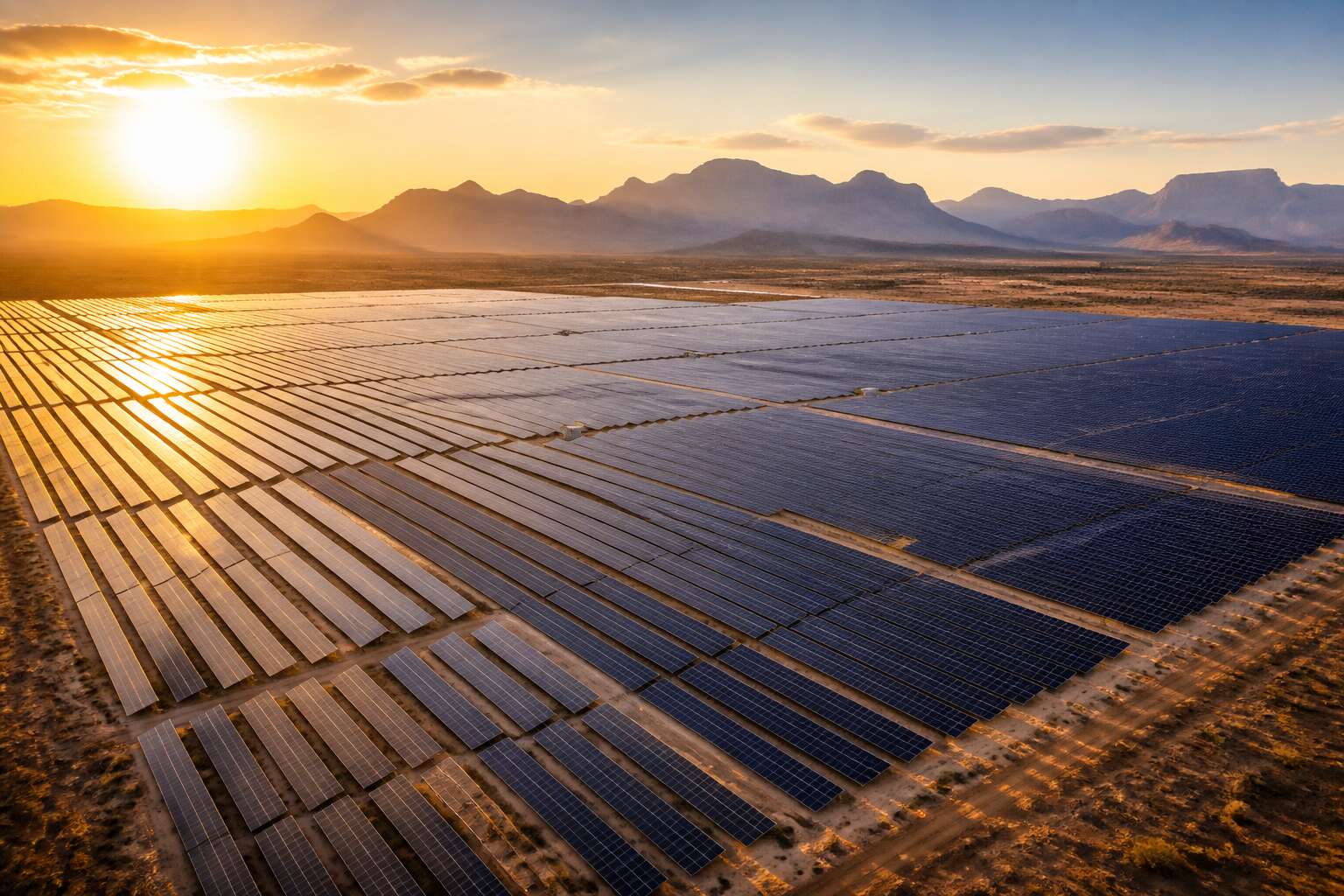
The Solar Energy Landscape in the Northern Cape
Geographic and Climatic Advantages
The Northern Cape receives more than 2,500 hours of sunshine each year, with direct normal irradiance levels that rival the Atacama Desert. This abundance makes the province a strong candidate for photovoltaic generation, which is why developers continue to fund northern cape solar farm projects.
Geography compounds the climatic advantage. Vast, flat expanses of semi-desert terrain provide unobstructed horizons, while dry air minimises light scattering and atmospheric interference. Low population density means large tracts of land remain available for utility-scale installations. Sparse vegetation reduces dust accumulation on panels.
Key geographic advantages include:
– High altitude plateaus with reduced cloud cover
– Stable, predictable dry seasons
– Existing grid corridors in certain regions
These conditions allow a northern cape solar farm to achieve capacity factors above the national average. Rare extreme weather events lower operational risk, and consistent irradiance ensures predictable energy output. The result is a solar landscape where technical and environmental factors align favourably.
The Growth of Renewable Energy in South Africa
Ask any energy analyst where South Africa’s solar future resides, and they will point to one province: the Northern Cape. The northern cape solar farm boom has turned a once quiet region into a prime location for solar development. Since 2020, provincial solar capacity has grown eighty percent.
That growth is no accident. Regulatory reforms under the renewable energy procurement programme allowed private bidders to enter long term agreements. Capital followed once grid connection rules relaxed. Now, municipal projects and corporate power purchase agreements share space with traditional IPPs.
- Thirty one operational solar farms have reached commercial operation in the province.
- Another dozen are under construction or in advanced development.
- De Aar alone hosts three large facilities.
I have watched these developments reshape local economies. Engineering firms, maintenance crews, and financial services now cluster near solar sites. What began as an energy transition has become a regional industrial shift.
Key Players in the Province’s Solar Industry
Some of the most enduring names in the global energy sector have placed their bets on the province. Multinational developers like Scatec, Enel Green Power, and JUWI have each established significant operational footprints. Their involvement signals more than just capital; it brings a layer of technical expertise that raises the bar for local engineering standards.
The financial architecture of these projects is just as interesting. Institutions like the Development Bank of Southern Africa and commercial lenders have structured complex debt packages for the northern cape solar farm projects. These agreements often include stringent performance milestones, which in turn drive innovation in plant management and grid stability practices.
An emerging tier of regional specialists adds local knowledge to the mix. Firms like the SOLA Group have pivoted from consultation to direct ownership, proving that the sector is not the exclusive domain of global giants.
1. SOLA Group, focused on commercial and industrial wheeling agreements.
2. JUWI, handling full turnkey engineering, procurement, and construction for private clients.
3. Red Rocket, managing a portfolio that blends wind and solar assets to balance supply.
These developers frequently source auxiliary services from local contractors. This creates a collaborative ecosystem where international best practices meet on the ground operational wisdom. The result is a resilient supply chain that adapts to the harsh climate conditions, ensuring the northern cape solar farm landscape remains a cornerstone of the national grid.
Solar Energy vs Traditional Power Sources
Northern Cape skies deliver more solar radiation per square metre than any other region in South Africa. A northern cape solar farm converts that resource directly into electricity. Traditional coal generation must first mine, transport, and grind its fuel, a chain of heavy machinery and logistics that solar simply skips.
The two systems behave differently on the grid. Coal plants run best at constant output. Solar plants track the sun, rising with the morning demand peak and easing off at night. In this province, the two curves fit together well. Consider the practical differences:
- Coal consumes vast amounts of water for cooling. Photovoltaic generation uses none.
- Coal emits ash and flue gas. Solar arrays produce no combustion by-products.
- Coal relies on a fragile supply chain. A northern cape solar farm needs only daylight.
Solar Radiation Levels and Irradiation Data
The Northern Cape’s solar resource is not merely abundant, it is a statistical outlier. Upington receives around 3,000 hours of sunshine each year, with average daily solar radiation exceeding 6.0 kWh per square metre. This is the kind of data that makes energy planners pause.
To grasp this, consider what it means for a northern cape solar farm. The high direct normal irradiance (DNI) levels, often above 2,500 kWh per square metre annually, place this region alongside the Atacama Desert and the Australian outback.
– The high altitude of the interior plateau reduces atmospheric interference.
– Dry, clear air allows more radiation to reach the panels.
– Minimal cloud cover ensures predictable generation curves.
This unique concentration of resources is why the province attracts serious investors. The irradiation data is not a marketing gimmick. It is a mathematical certainty that drives project viability, turning a sun-drenched landscape into a bankable asset. Generation yields here outperform other South African provinces by a noticeable margin. The sun’s energy here is a physical force that is measured, documented, and harnessed with deliberate precision.
Major Solar Farm Projects Driving the Region
Utility-Scale Solar Installations
Utility-scale installations now produce the dominant share of the province’s renewable output, with the northern cape solar farm portfolio leading that shift. Several plants operate above 75 MW and feed directly into Eskom’s high-voltage corridors. Each site spreads thousands of photovoltaic modules across tracts of hardened earth, using single-axis trackers that rotate slowly through the day.
Construction at this scale brings unusual constraints. Water for panel cleaning arrives by truck in the drier districts, and substation upgrades must be sequenced before energisation can occur. Developers handle these pressures by phasing array rollouts and pairing battery storage on the same footprint.
- Kathu Solar Park: 100 MW, parabolic trough design
- Aggeneys Solar Facility: 85 MW AC, single-axis tracking
- Konkoonsies II: 75 MW, thin-film technology
These installations anchor the northern cape solar farm growth story, proving that arid, remote locations can host generation on par with conventional power stations.
Community-Based and Independent Power Producers
While utility scale plants capture headlines, a quieter revolution unfolds on smaller parcels of land. Community based projects and independent power producers are stitching solar into the region’s social fabric, often with more modest footprints but equally profound impacts. These ventures prioritise local employment and skills transfer, turning the northern cape solar farm narrative into a story about people, not just panels.
The Prieska project is one such example, where a portion of the revenue directly funds a local education trust. Here, the photovoltaic array is a partner in rural development rather than a distant industrial fixture. Several independent producers lease land from communal farms, negotiating terms that bring consistent income to families who have weathered decades of drought.
– The Lesedi Solar Park allocates a percentage of its operational budget to local healthcare initiatives.
– The De Aar 1 and 2 projects have established training centres for maintenance technicians.
– The Klein Begin solar facility operates a mentorship programme with local engineering students.
Each northern cape solar farm of this scale operates within a tight ecosystem. They manage grid curtailment by shifting maintenance schedules and rely on weather forecasting to time their sales into the daytime peaks. This interplay between technology and rural reality is delicate, yet it holds. The results show that clean energy can be a foundation for community wealth, not only a source of megawatts. The cumulative effect of these smaller installations is a distributed network of resilience, one that strengthens both the national grid and the local economy in equal measure.
The Role of the REIPPP Programme
REIPPP bid windows have funnelled billions in private capital into the province’s solar pipeline. The competitive auction model forced developers to sharpen environmental and social performance alongside tariff reductions, and the northern cape solar farm sector has absorbed a significant share of that investment.
Consider the clustered projects that emerged from bid window three and four. They share substations, transmission lines, and weather risk, yet each operates under distinct ownership structures. I find this diversity remarkable for a single region.
The northern cape solar farm landscape now includes:
– Hybrid plants pairing solar with battery storage
– Projects with black economic empowerment shareholdings exceeding 30 percent
– Developments financed entirely through local banking consortia
REIPPP’s local content requirements have also pushed module assembly and mounting structure manufacturing into the province. What began as a procurement instrument now anchors a regional industrial base.
Notable Solar Parks and Their Capacity
More than a gigawatt of solar capacity now stands across the Northern Cape, but the numbers only tell part of the story. Travel the gravel roads between Upington and De Aar and you will find plants that behave very differently. Kathu Solar Park runs on parabolic troughs, storing heat in molten salt. De Aar Solar Power feeds 85 MW of photovoltaic output directly into the grid. Sishen Solar Facility adds 74 MW beside an iron ore mine.
The northern cape solar farm sector is no longer just about panels and mirrors. Storage has arrived. Kenhardt, near the Namibian border, pairs 540 MW of solar with 225 MW of batteries. It shifts afternoon sunlight into the evening peak.
Key installations by scale:
– Kathu Solar Park: 100 MW
– KaXu Solar One: 100 MW
– Xina Solar One: 100 MW
– De Aar Solar Power: 85 MW
– Sishen Solar Facility: 74 MW
What strikes me is the ownership mix. Some plants sit with international funds. Others are held by local consortia with meaningful black economic empowerment stakes. The infrastructure is shared, yet the strategies differ.
International Partnerships and Funding
South Africa’s solar push has turned the region into a magnet for foreign capital. The R2.1 billion Kenhardt complex, partly funded by a European investment bank, shows how the northern cape solar farm sector relies on cross-border money. International partners often bring technical expertise, not only financing. Norwegian and German funds hold stakes in several parabolic trough plants here. This shifts risk away from local utilities. However, conditions apply. Local ownership requirements remain central. Funding flows through several channels:
- Development finance institutions
- Green energy venture capital
- Export credit agencies
That mix keeps the projects alive during currency swings. The northern cape solar farm growth depends on this fragile balance between global lenders and local regulation. De Aar’s expansion, for instance, waited three years for loan approval. Patience pays, though. Solar output now outpaces several coal units.
Decommissioning and Repowering Projects
In 2023, Eskom retired three coal units at the Komati power station. Their substations did not sit empty. Northern cape solar farm developers have repurposed those grid connections, feeding clean power through the same transmission lines. This decommissioning and repowering cycle is not a side effect. It is a strategic shift. De Aar’s substation, once built for coal haulage, now routes solar electricity to the national grid.
- The Kenhardt complex uses infrastructure originally owned by a coal mine
- Two former ash dams at a decommissioned plant now support PV panels
- A mothballed turbine hall houses inverters for a solar park
These moves reduce capital costs. They can also cut permitting time by half. As more coal units retire, northern cape solar farm capacity will take their place. I have watched this pattern repeat across the province. That is the repowering reality.
Economic and Environmental Impact of Solar Farms
Job Creation and Skills Development
The quiet hum of a transformer has replaced the sound of wind across the Karoo dust. A northern cape solar farm changes more than the skyline, it reweaves the economic fabric of small dorps. Local business owners see new faces at their counters, and the demand for services like security and transport has quietly multiplied. This cash injection is not a temporary flicker; it is a steady current that keeps money circulating within the community long after the construction crews have left.
Job creation is the most tangible benefit for residents, moving beyond the initial build phase into lasting operational roles. The daily work of managing a solar plant requires a specific skill set, and training programs have become a lifeline for young adults. Technicians now troubleshoot inverters and monitor grid synchronisation, trades that were once impossible to learn without leaving the province. The employment structure typically includes:
– Security personnel for site monitoring and asset protection
– Plant operators managing daily performance and yield
– Maintenance crews for panel cleaning and preventative care
– Administrative staff for reporting and community liaison
Skills development through these projects builds a local workforce that is resilient to economic downturns. The knowledge gained from a northern cape solar farm extends beyond the control room, as workers gain confidence in a modern industrial environment. This capacity building ensures that when new projects come online, the province has a ready pool of qualified people. The environmental dividend is equally clear. These farms produce energy without consuming vast amounts of water, a critical factor in a region where every drop counts. The land, once considered marginal for agriculture, now hosts panels that convert sunlight into a valuable export on the national grid.
The ecological footprint of a northern cape solar farm is small, yet its impact on local biodiversity is carefully managed. Vegetation is preserved where possible, and the shadow cast by panels provides a cooler microclimate in the harsh summer months. As the sun sets and the immediate workday ends, the long term value of these installations becomes clear. They offer a path to consistent employment and a cleaner energy future, all anchored in the same red earth that has supported generations of farmers.
Contribution to the National Grid
The sheer volume of power flowing from a northern cape solar farm is a marvel of modern engineering. When the sun peaks over the horizon, these plants inject gigawatts of clean energy directly into the national grid, stabilising a system that has faced immense pressure. This contribution reduces the reliance on fossil fuels during peak demand hours.
The economic ripple effect is measurable in the price of electricity. By flooding the market with renewable energy during the day, a northern cape solar farm helps to lower the average cost of power for every South African consumer. It is a strategic asset, not just an environmental statement.
– Grid stability is enhanced through rapid response to demand fluctuations.
– Energy losses are minimised by generating power close to the transmission lines.
– The national utility benefits from reduced maintenance on traditional plants.
Furthermore, the environmental dividend is significant. These farms operate without consuming water for cooling, a critical advantage in a water-scarce province. The land, often considered degraded, is repurposed for high-value energy production, ensuring that the region contributes to national energy security without sacrificing its fragile ecology.
Land Use and Biodiversity Considerations
A northern cape solar farm redefines what productive land can mean. Thousands of hectares once used for marginal grazing now host photovoltaic arrays, but the ecological story is more nuanced than simple replacement. Ground cover persists between panel rows, and certain bird species use the structures as perching sites. The economic impact extends into land rental agreements that give farmers a stable income independent of rainfall.
Biodiversity considerations shape design choices. Developers survey the site for sensitive species before construction, and operational protocols protect the soil crust that prevents dust storms.
- Panel spacing preserves natural drainage channels.
- Fencing allows small mammals to move through the perimeter.
- Vegetation management favours indigenous grasses.
The long-term value of these installations depends on compatibility with the Karoo’s fragile ecology, a balance that decides whether industrial energy generation remains a permanent feature of the Northern Cape landscape.
Socio-Economic Benefits for Local Communities
A northern cape solar farm does more than feed the national grid. It redirects capital into municipal coffers through property rates and lease payments, which fund water pipelines and road maintenance in towns like De Aar and Upington.
Environmentally, each installation avoids thousands of tonnes of CO2 annually. The quieter gain is water. Solar PV uses negligible amounts compared to wet-cooled coal plants, leaving scarce Karoo aquifers untouched.
The socio-economic ripple reaches households directly:
- Community trusts receive dividends that finance bursaries and clinics.
- Local caterers and security firms win service contracts.
- Seasonal vegetation crews earn stable wages beyond the harvest cycle.
These flows make a northern cape solar farm an economic anchor in a region where drought often dictates livelihoods.
Carbon Emission Reductions and Climate Goals
Every northern cape solar farm quietly retires millions of kilograms of carbon dioxide each year. The arithmetic is simple: solar displaces coal, coal stays underground, and the atmosphere benefits. Climate goals in South Africa often stumble under load shedding, yet these installations keep producing without complaint.
The emissions ledger is stark and encouraging. One utility scale plant offsets what thousands of cars emit annually. That is not poetry, it is calculation. Carbon reductions here feed directly into national pledges under the Paris Agreement.
In practical terms:
- Each megawatt generated avoids roughly 1.2 tonnes of CO2 per year.
- Solar farms shorten the payback period for climate investments.
Technological Innovations and Advancements in Solar Power
Solar Photovoltaic vs Concentrated Solar Power
Technology in the northern cape solar farm sector has moved past simple panels. Photovoltaic systems now rely on bifacial modules that capture light from both sides, while single axis trackers follow the sun’s arc across the Karoo. These refinements raise yield without expanding the land footprint, a critical factor in this arid province.
Concentrated solar power takes a different route. Mirrors focus sunlight to heat a fluid, which then drives a turbine. The decisive breakthrough is thermal energy storage, often using molten salt, allowing electricity dispatch after sunset. That capability changes grid stability and shifts the economic calculus for operators.
- Bifacial PV modules with rear side irradiance capture
- Heliostat fields with digital aiming algorithms
Hybrid designs now integrate both technologies, sharing infrastructure and smoothing output curves. For any northern cape solar farm, dry air and high direct normal irradiance amplify every innovation, making these systems more productive here than in humid climates.
Battery Storage and Grid Stability
The sun sets, but the northern cape solar farm doesn’t have to stop working. Battery storage is rewriting the rules of the evening energy peak. Lithium-ion units, packed in rows of white containers, absorb excess midday generation and release it precisely when demand surges after dark. This shifts the province from a daytime-only producer to a round-the-clock asset on the national grid.
Thermal storage already solved the overnight question for concentrated solar plants, but the new wave is chemical. The integration of large-scale battery systems addresses the intermittency that once made solar a difficult partner for Eskom. Operators can now smooth the output curve and provide ancillary services, like frequency regulation, that keep the grid stabilised during faults or load shedding events.
Grid stability in the Karoo also depends on hardware. Inverter technology has advanced to provide grid-forming capabilities, allowing renewable plants to actively set voltage and frequency rather than just following the grid’s lead. This is a crucial upgrade for the northern cape solar farm sector, moving these plants from passive generators to active participants in system security. The result is a more resilient network, capable of handling higher renewable penetration without compromising on reliability. This resilience is the true value proposition driving new investment in the region.
Smart Solar Farming Techniques
A single drone sweep can inspect thousands of panels before the midday heat builds, catching microcracks and loose connections that would otherwise cut output. That saves hours of manual inspection! On a northern cape solar farm, this aerial vigilance turns reactive repairs into planned maintenance. Thermal cameras detect heat anomalies, while machine vision grades each module’s health instantly.
Smarter farming techniques go beyond inspection. Three upgrades are changing daily operations:
- Single-axis trackers tilt panels toward the sun’s arc, lifting capture by up to 25 percent compared to fixed mounts.
- Automated cleaning robots scrub dust off modules during dry spells, preserving output without wasting water.
- AI-driven forecasting schedules maintenance around weather fronts, so crews avoid working in heat or storms.
Hybrid Renewable Energy Systems
Where the Karoo horizon swallows the sun, the northern cape solar farm now works in tandem with the region’s restless winds. Hybrid renewable energy systems couple photovoltaic rows with turbine towers, sharing substations and grid connections. This pairing smooths the inherent variability of each source. One moment belongs to the sun, the next to the wind, and the northern cape solar farm harvests both without preference.
Hybrid inverters reconcile alternating and direct current across the same infrastructure. When clouds throttle solar output, the turbines take the load. When the wind dies, battery banks carry the night. Dispatchable power emerges where intermittent generation once faced curtailment. Grid operators now treat solar as a scheduled contributor rather than an unpredictable guest, and the province’s energy architecture finally reflects that certainty.
Tracking Systems and Efficiency Enhancements
The northern cape solar farm now employs tracking systems that follow the sun’s arc with mechanical patience. Single-axis trackers tilt north to south, while dual-axis systems adjust for seasonal declination. These movements add hours of productive generation each day.
Bifacial modules capture albedo from the gravel plain below. Anti-reflective coatings and half-cut cell architectures reduce losses. Machine learning algorithms now predict cloud movement and adjust panel angles before irradiance drops. I have watched these adjustments happen in the control room, and the response is immediate.
Modern tracking adds measurable gains:
- 15 to 25 percent yield improvement over fixed tilt
- Reduced soiling losses through automated cleaning cycles
- Real-time irradiance sensors feeding back to inverter controls
The tracking hardware itself has become more robust, with fewer moving parts and better bearings designed for Karoo dust.
Challenges and Future Outlook for Solar Farms in the Northern Cape
Water Scarcity and Dust Management
Water scarcity is the defining constraint for any northern cape solar farm. The region receives less than 100mm of annual rainfall, yet solar panels require regular cleaning to maintain efficiency. Dry, dusty conditions mean soiling losses can reduce output by up to 15% without intervention. Groundwater reserves are already under pressure from agriculture and municipal demand, so solar developers cannot rely on traditional washing methods.
In my experience, operators are turning to waterless cleaning methods:
- Robotic dry-cleaning systems that traverse panel rows
- Hydrophobic coatings that prevent dust adhesion
- Electrostatic repulsion technology that dislodges particles with electrical charges
Each approach has trade-offs in cost, durability, and maintenance frequency.
The future outlook depends on how well these technologies scale. A northern cape solar farm that masters dust management without depleting groundwater reserves will set the benchmark for arid-region solar development across Africa.
Grid Connection and Transmission Bottlenecks
Every megawatt generated in the Northern Cape must travel hundreds of kilometres to reach demand centres in Gauteng and the Western Cape. The transmission network was never designed for this volume of renewable energy. Grid connection queues stretch for years, and some northern cape solar farm projects face curtailment during peak generation hours.
The bottlenecks are not merely physical. Between environmental approvals, wayleave permissions, and Eskom’s connection capacity assessments, developers wait longer for paperwork than for equipment delivery. I have seen projects pivot to wheeling arrangements or private off-take agreements, but the high-voltage lines themselves remain the limiting factor.
- Anticipated transmission upgrades are already mapped in Eskom’s development plan
- New 400kV corridors will eventually link Upington to the national grid
- Battery storage at substation level could smooth peak export constraints
The future outlook hinges on whether infrastructure investment keeps pace with solar development. If those corridors materialise on schedule, the province’s generation capacity will finally release its full potential.
Regulatory and Policy Hurdles
Regulatory approvals for a northern cape solar farm require patience. Environmental authorisations, water use licences, and municipal permissions each follow separate timelines. Policy uncertainty around wheeling tariffs and licence exemptions creates additional friction.
Yet the future outlook holds promise. The Electricity Regulation Act is under revision, and the Northern Cape government has simplified some local approval processes. Developers already report faster zoning certificate turnaround.
- Spatial Development Framework alignment
- Single-point application portals
- Standardised environmental assessment criteria
These measures could unlock stalled projects. A solar farm that navigates current bureaucracy will benefit from falling panel costs and stronger off-take demand. The province’s regulatory environment is evolving, and the direction favours clarity.
Investment Opportunities and Market Trends
Regulatory friction remains a genuine cost for any northern cape solar farm, but the arc of change bends toward pragmatism. The revision of the Electricity Regulation Act, paired with provincial efforts to streamline local approvals, signals a shift from theory to practice. Developers report that zoning certificates now move faster, and the introduction of single-point application portals is cutting weeks off project timelines. These are not cosmetic tweaks.
Consider the practical measures already taking shape:
– Alignment with the Spatial Development Framework
– Standardised environmental assessment criteria
– A unified application process for multiple permits
The commercial logic is straightforward. A northern cape solar farm that clears hurdles today locks in construction costs while panel prices slide. Off-take demand strengthens as more commercial buyers seek fixed-rate power. The province’s regulatory environment is evolving, and the direction favours clarity. Investors who act now stand to benefit from a market that is becoming more accessible, not less. The infrastructure is ready, the sun is relentless, and the paperwork is finally catching up to the ambition.
The Road Ahead for Renewable Energy in the Province
Challenges remain, but they are more human than technical. The biggest risk to any northern cape solar farm is not panel degradation or inverter failure. It is the slow loss of institutional memory. Skilled technicians trained during the construction boom are being courted by overseas projects, while municipalities that once struggled with applications now struggle to retain planning officers who understand the sector’s nuances.
Looking ahead, three factors will shape the next decade:
- The pace of skills transfer to local communities
- The maturity of secondary markets for used panels
- The alignment of municipal budgets with solar asset lifespans
None of these register in irradiance models, yet they determine whether the province’s solar momentum holds. The northern cape solar farm landscape is shifting from a period of large-scale construction to one of portfolio management. That transition demands different expertise. The sun will keep producing, but the institutions around it must adapt.
Community Engagement and Social License to Operate
The sun does not negotiate, but a northern cape solar farm must learn to. Trust is the invisible current that powers everything, and it is earned in small rooms with folding chairs and warm tea. Communities want to know who stands behind the fence and what happens when the wind changes. I’ve seen this dynamic shift a project’s timeline more than any technical hurdle.
Social license to operate is a fragile covenant. When a northern cape solar farm engages properly, it stops being an installation and becomes a neighbour. That distinction sounds small, yet it determines whether a project thrives or merely exists. Residents seek clarity about employment pathways and land use commitments. They ask about water consumption during construction and cleaning schedules during drought.
– Transparent grievance mechanisms that address concerns within days
– Local procurement contracts that favour nearby suppliers first
– Educational partnerships that turn schoolyards into demonstration sites
The most enduring projects treat these conversations as ongoing, not occasional. They track their reputational health as diligently as their generation metrics. The technology is proven. The relationships require constant tending.


0 Comments